
Yutakamidori ゆたかみどり
Yutakamidori is Japan's second most cultivated tea cultivar, originating from a rare self-pollination of Asatsuyu in 1934 and selected in 1949, though it was never officially registered. Despite being bred in Shizuoka...
Yutakamidori is Japan's second most cultivated tea cultivar, originating from a rare self-pollination of Asatsuyu in 1934 and selected in 1949, though it was never officially registered. Despite being bred in Shizuoka, approximately 95% of Yutakamidori is grown in Kagoshima Prefecture representing about 30% of the prefecture's tea cultivation. This early-budding, high-yielding cultivar is susceptible to cold weather, limiting its cultivation to southern Japan.
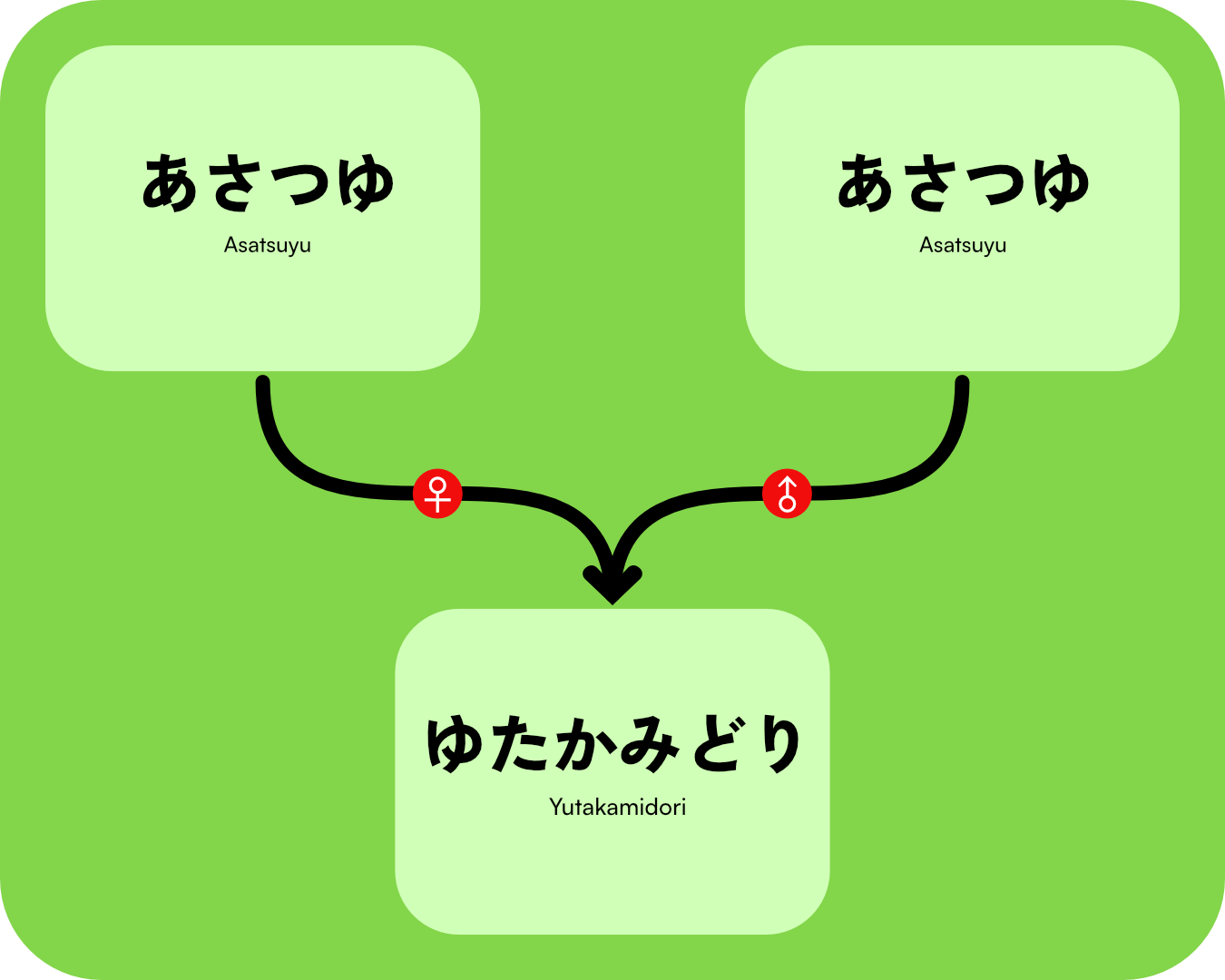
Lineage
- Asatsuyu[1]♀
- Asatsuyu ♂
Self-pollination crossing
History
Yutakamidori is a seedling emerged from a rare self-pollination cross of the Asatsuyu cultivar. Pollination took place in 1934 and Yutakamidori was chosen in 1949. In 1950, it was designated as U14-1 and later renamed Y2 during its growing tests at the old national tea research station. Today it’s the Kanaya National Tea Research Centre, managed by NARO in Shizuoka.
Nationwide adaptability tests were conducted from 1954. It was never registered, this made gathering information difficult. Despite this, it’s the second most cultivated cultivar in Japan, though still behind Yabukita. Information on Yutakamidori is scarce and focuses on a few specific topics.
Those include its large prevalence in Kagoshima Prefecture, where it represents around 30% of the total cultivated land, closing in on the 40% cultivated area of Yabukita. Yutakamidori is the second most grown cultivar in Japan at around 7% according to 2020 data. Seen from a different perspective, around 95% of the cultivation of Yutakamidori is located in Kagoshima Prefecture.
One key factor is its susceptibility to cold, which makes it a cultivar primarily grown in southern Japan’s milder climates. Being an early cultivar also complicates its cold tolerance management. Sencha is its main use, especially deep steamed, used to enhance and develops its flavour.
Shading is also highlighted as a key technique for suppressing astringent compound production. This is mentioned numerous times in the limited material I found about Yutakamidori. Typical mentions include astringency and off colour. However, deep steaming and high firing temperatures develop a much mellower, sweeter and nutty experience. Interestingly, these unorthodox yet now common processing methods weren’t tested during the testing phase.
These combined factors likely contributed to its exclusion from official registration. However, it still achieved second place in cultivated area and was promoted as a cultivar for Kagoshima Prefecture in 1966. The prefecture named it Yutakamidori. The name’s origin might be Minoru Shimonodozo’s son, Yutaka Shimonodozo.
Minoru Shimonodozo is believed to have played a crucial role in popularising Yutakamidori, particularly in its processing. The name might be a play on Minoru’s son, and the meaning of the Japanese word yutaka[2] translates to abundant. It’s also simply a descriptor for a high-yielding cultivar. I’ve read conflicting information from various sources, so pinpointing the exact reason is difficult. I believe the naming simply describes the high-yielding qualities of the cultivar, much like other names such as Okumidori, which relate to its late growth. However, some cultivars developed by individual farmers are named after their sons and daughters.
Breed in Shizuoka, grown in Kagoshima
Exploring the history of Yutakamidori, an unregistered cultivar, presents a challenge. I’ll share some material I’ve found, heavily relying on Shimonodozo, a prominent tea company in Kagoshima, and a thesis examining the evolution of tea businesses. A few intriguing and consistent details warrant mentioning, but please approach the entire explanation with a healthy dose of scepticism.
As mentioned, the initial crossbreeding took place in the mid-1930s and was then studied from the 1950s onwards. A researcher from the Kagoshima Prefecture Tea Research Station, Okamura Katsuro[3], is credited with introducing the Y2 strain from Shizuoka to Kagoshima.
The farmers of Kagoshima were quickly captivated by the promising new cultivar, eventually becoming Yutakamidori. Its early growth and good yields captured their interest.
Okamura Katsuro was also involved in breeding other cultivars, such as Asanoka[4], which was registered in 1996. Following the initial field development, production time arrived. Applying standard processing techniques to Yutakamidori resulted in an astringent tea with a slightly reddish tint. The characteristics that wouldn’t appeal at auction, and the taste was described as “barely tea”.
There was a lot of backlash from the farmers, this cultivar, together with a big push towards increasing the production and the quality of the area in Kagoshima, represented the hopes and dreams of a generation of Kagoshima tea farmers.
At the time, Kagoshima prefecture also produced tea as a bulk agent and shipped it to Shizuoka or Uji for sale. It was considered a cheap, low-quality bulking agent. However, Kagoshima had been cultivating tea for many years, with the Shimazu clan leading the effort in the Kagoshima area and making it one of its key product. The area’s production of tea didn’t reach its current levels until after World War II. This was due to a surge in available farmland, which was reconverted from other uses, including many military ones.
Alongside a drive to develop black tea production and suitable for black tea cultivars, there was a push to improve the quality of green tea production in the area. This also involved moving beyond the area’s established reputation for low-quality green tea.
When the first Yutakamidori harvest arrived with underwhelming results, farmers were understandably frustrated. Planning and cultivating new fields takes considerable effort and time, typically three to five years before a small test harvest is possible. Okamura Katsuro, a key figure in promoting the cultivar in the region, bore much of the farmers’ frustration. However, according to the limited information I’ve gathered, Minoru Shimonodozo played a crucial role in breaking down this problem.
Through numerous trials and errors, Minoru developed a more unorthodox processing approach involving significantly higher temperatures. This style is now well known in Kagoshima, with its deep steaming and heavy firing, resulting in a bold and sometimes nutty flavour profile in the dry leaf.
Deep steaming techniques began developing around the 1950s and 1960s, slightly after the breeding of Yutakamidori. This method wasn’t widely adopted until the mid-60s to early 70s. The timing of these developments and Minoru’s improvements to Yutakamidori’s teas seems almost coincidental. While this is mainly my speculation, deep steaming, combined with shading, can round out a tea and even mask unwanted flavours from either the cultivar itself or other factors.
Despite challenges, the exploration of high-temperature processing and shading techniques on Yutakamidori bushes proved successful. These methods preserved sweetness and enhanced colour, bringing Yutakamidori back into the game. The tea gained popularity and Yutakamidori usage significantly increased. Although it still trails behind Yabukita, accounting for only about 7% of Japan’s total tea production. Almost all of it is produced in Kagoshima prefecture, which grows approximately 95% of it. In 2012, Yutakamidori tea made up 28% of the prefecture’s finished tea output, compared to Yabukita’s 37%. This represents an estimated 26,000 tonnes of tea produced in Kagoshima that same year.
Characteristics
Yutakamidori is a sencha cultivar, particularly kabuse, known in Kagoshima for its deep steamed style and high firing. It’s an early budding cultivar with a good yield, but is more astringent than Yabukita and susceptible to cold. This is why it is mainly grown in Kagoshima or other southern regions. In terms of pests, it is a cultivar resistant to antrachnose.
Being an unregistered cultivar means there’s limited publicly available information on its bush behaviour under various growing conditions. At the time of writing I had the pleasure of speaking to a researcher from the Shizuoka Prefectural Tea Research Centre who generously shared some valuable insights. This conversation also clarified a longstanding question: are there any actual data on these cultivars that aren’t part of the registration process? Yes, though it’s not publicly accessible it’s stored in breeding institutions in raw format. This vast collection of trial data is challenging to digest and understand.
Yutakamidori is a high-yielding cultivar that buds early, about a week before Yabukita. Harvesting it five to seven days earlier than Yabukita results in a high yield, almost doubling that of Yabukita. This yield remains fairly consistent throughout different harvesting seasons. The brewed liquor has a reddish tint and a noticeable astringency, as mentioned in the history section. Farmers introduced shading techniques from other prefectures and employed high firing and steaming to address these issues. These production methods produce a rich flavour, a green colour and a mild sweetness.
Yutakamidori is one of the few cultivars containing methylated catechin, though in much lower amounts than others. Benifuki currently boasts the highest concentration with a study reporting 2.1% of its dry matter compared to Yutakamidori’s 0.2%. Okuyutaka, a descendant of Yutakamidori, also lacks measurable amounts of methylated catechin in the same study. However, EGC/EGCG values are slightly higher than other cultivars, which might explain its more pronounced astringency unless grown with shading. Kagoshima also benefits from hot weather with long hours of sunlight, which accentuates the bitter and astringent taste of Yutakamidori.
Yutakamidori holds a unique position as Japan’s second-largest tea cultivar, primarily grown in Kagoshima Prefecture. It’s a representative cultivar of the region. Another well-known Kagoshima cultivar, Saemidori, ranks third nationally and thrives in the warm climate. In terms of taste, they are seemingly completely opposite. Saemidori is much milder and sweeter, consistently fetching the highest average prices at tea auctions.
Kagoshima also grows other early-maturing cultivars such as Asatsuyu. These benefit from the warm weather and early growth, like Yutakamidori, allowing them to reach the market more quickly in spring. Often leading to higher prices in the tea market.
References
Chikiriya. “お茶の品種| お茶コラム| 京都 三条「ちきりや」お茶通販 創業安政元年.” _Kyo-Chikiriya.com_, 2024, kyo-chikiriya.com/blog/tea_about/variety/.
Shimodozono. “「ゆたかみどり」.” _Ocha-No-Shimodozono.jp_, 2022, www.ocha-no-shimodozono.jp/lp/.
MAFF. _Ministry of Agriculture, Forestry and Fisheries_, www.maff.go.jp/j/kanbo/kihyo03/gityo/tuyomi/pdf/05-02tya.pdf.
Shimonodozo. “静岡生まれ・鹿児島育ちの「ゆたかみどり」” _Shimo.co.jp_, 2024, https://shimo.co.jp/ゆたかみどり物語/. Accessed 10 Dec. 2024.
優しいのみもの. “ゆたかみどり.” _優しいのみもの_, 27 July 2020, linderabella.hateblo.jp/entry/cha/leaf/yutakamidori. Accessed 10 Dec. 2024.
塩原大輝. “ゆたかみどりとは?鹿児島の温暖な気候で育ったコクが豊かなお茶の品種.” _巣鴨のお茶屋さん山年園_, CHANOYU, 13 Apr. 2024, www.e-cha.co.jp/contents/yutakamidori/. Accessed 10 Dec. 2024.
静岡茶共同研究会 編ほか. 深蒸し茶のルーツ : サントリー文化財団2013年度地域文化に関するグループ研究助成「静岡の茶業と茶文化の共同研究と発信による地域振興」報告書, 静岡大学人文社会学部小二田研究室, 2014. https://ndlsearch.ndl.go.jp/books/R100000002-I025595597
静岡県茶業会議所 著. 新版 茶の品種. 静岡県茶業会議所, 2019.
Last update: 2025 December 14th
Added footnotes, top summary, improved overall text structure, and removed redundancies.