
Terakawa-wase 寺川早生
Terakawa-wase is an early-flushing tencha cultivar. Toshio Terakawa selected it from Uji zairai seedlings and registered it privately in 1990. It yields high, flushes earlier than Asahi, and resists cold, blue and red blight, and laceration frost.
Terakawa-wase is an early-flushing tencha cultivar. Toshio Terakawa selected it from Uji zairai seedlings and registered it privately in 1990. It yields high, flushes earlier than Asahi, and resists cold, blue and red blight, and laceration frost.
Lineage
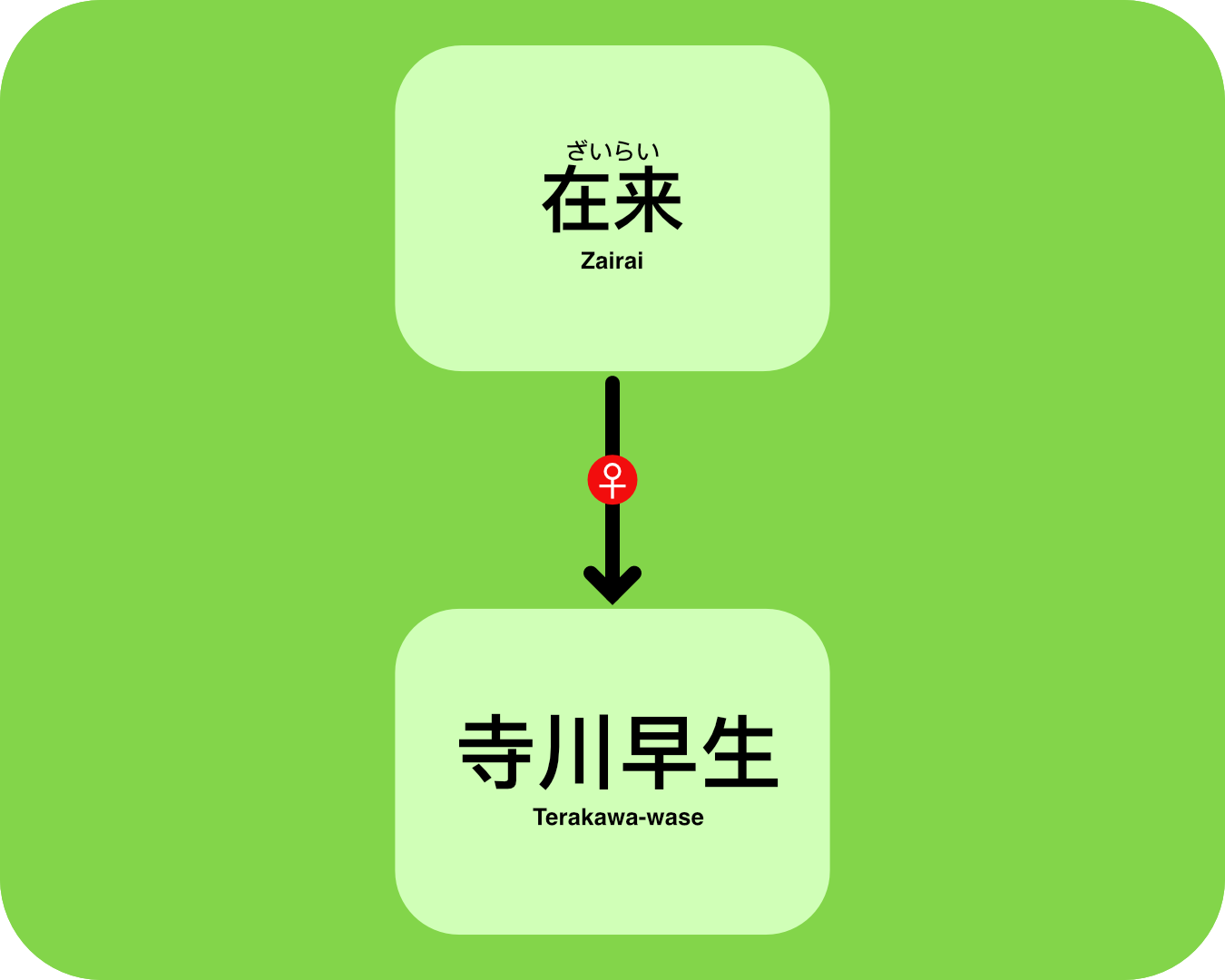
- Kyoto Uji landrace Zairai tea tree seed.
History
Terakawa-wase is a cultivar selected from seedlings of a zairai tea plant in Uji, Kyoto Prefecture and registered as a private cultivar by Toshio Terakawa[1] in 1990 with registration No. 2092. As a privately developed cultivar, it has less official information than other strains; as a result, it's even harder to find reliable information beyond potentially unreliable sources. Terakawa-wase is regarded as a cultivar for tencha production, although you can also find some leaf tea made with it, like Gyokuro.
Because data on this cultivar are limited, it is also difficult to estimate how much is cultivated, both in terms of land area and regions. It is not listed in the Kyoto Prefecture recommended cultivar list, but it is still an important cultivar that shows how differences across Uji areas behaved in terms of zairai populations and how private breeding and cultivar selection were carried out around Uji at the time. Samidori and Asahi are other examples of cultivars selected by private farmers. Terakawa-wase also does not appear in any NARO datasets, which cover nationally funded cultivars, nor in any DNA-ID sets or SSR fingerprints protecting it. Additionally, the breeder's rights expired in February 2002.
Characteristics
This cultivar is early-flushing in both bud break and harvest at its place of origin in Uji City; no data are available from other areas. It is reportedly a high-yielding cultivar compared to other similarly early-flushing cultivars. It can be harvested even earlier than Asahi, which is already early.
Terakawa-wase[2] has strong vigour, with wide spread and a thick canopy. It has many branches and a medium internode distance. The canopy has a moderate to high yield when young and a high yield once established.
The shoots are slightly large and relatively long, and moderately uniform. They are numerous, with a high 100-bud weight. The leaves are elliptical, large, thin, and pale green. The leaves have a soft texture and a moderate sheen. Mature leaves are medium-sized and share most traits with the younger leaves, but they are more wrinkled, and the leaf rim has a slight undulation.
Its tencha leaf as a finished product is a bit divisive, with the text accompanying the registration reporting excellent appearance, shape, and colour, with a good aroma and an excellent flavour. In an established producer house, it is praised for its high yield while mentioning its "rather poor quality when used for tencha".
This further shows how release papers can act as a sounding board for this cultivar's profiles. Those studies span multiple years, prefectures, researchers, and tasting panels, providing a useful average and filter across these conditions. That said, for such a specific cultivar, it may perform excellently in its origin location and less so elsewhere. In particular, for cultivars with so little information, this is extremely difficult to comb through.
In terms of climate and pest resistance, Terakawa-wase is cold-hardy and resistant to blue and red blight and laceration-type frost damage. Its resistance to anthracnose and ring spot disease is moderate.
寺川俊男 ↩︎
The term wase (早生) denotes some early-ripening cultivars, in contrast to the much less common okute (晩生). These words are commonly seen in research articles, not necessarily in names. These markers apply not only to tea but also to other plant strains like rice, where they are commonly written as (早稲) vs (晩稲). ↩︎
References
-
Terakawa, Toshio. "登録番号第2092号" [Registration Number 2092]. 品種登録迅速化総合電子化システム [Plant Variety Protection and Seed Registration System], Ministry of Agriculture, Forestry and Fisheries, 6 Feb. 1990, www.hinshu2.maff.go.jp/vips/cmm/apCMM112.aspx?TOUROKU_NO=2092&LANGUAGE=Japanese.
-
Matcha Yu Tea. "What's the secret to Award Winning Tea?" YouTube, uploaded by Matcha Yu Tea, 20 June 2019, www.youtube.com/watch?v=GIRL73fImfw. (interview with Toshio Terakawa, who isolated and registered the cultivar. Thank you Erin!)