
Tenmyo 展茗
Tenmyo is a tencha cultivar from Kyoto that was selected from open-pollinated Samidori seed and registered in 2006. It starts budding 1 to 2 days after Yabukita, produces a high yield, and works well with machine harvesting. This cultivar is grown only in Kyoto Prefecture, covering about 8 hectares.
Lineage
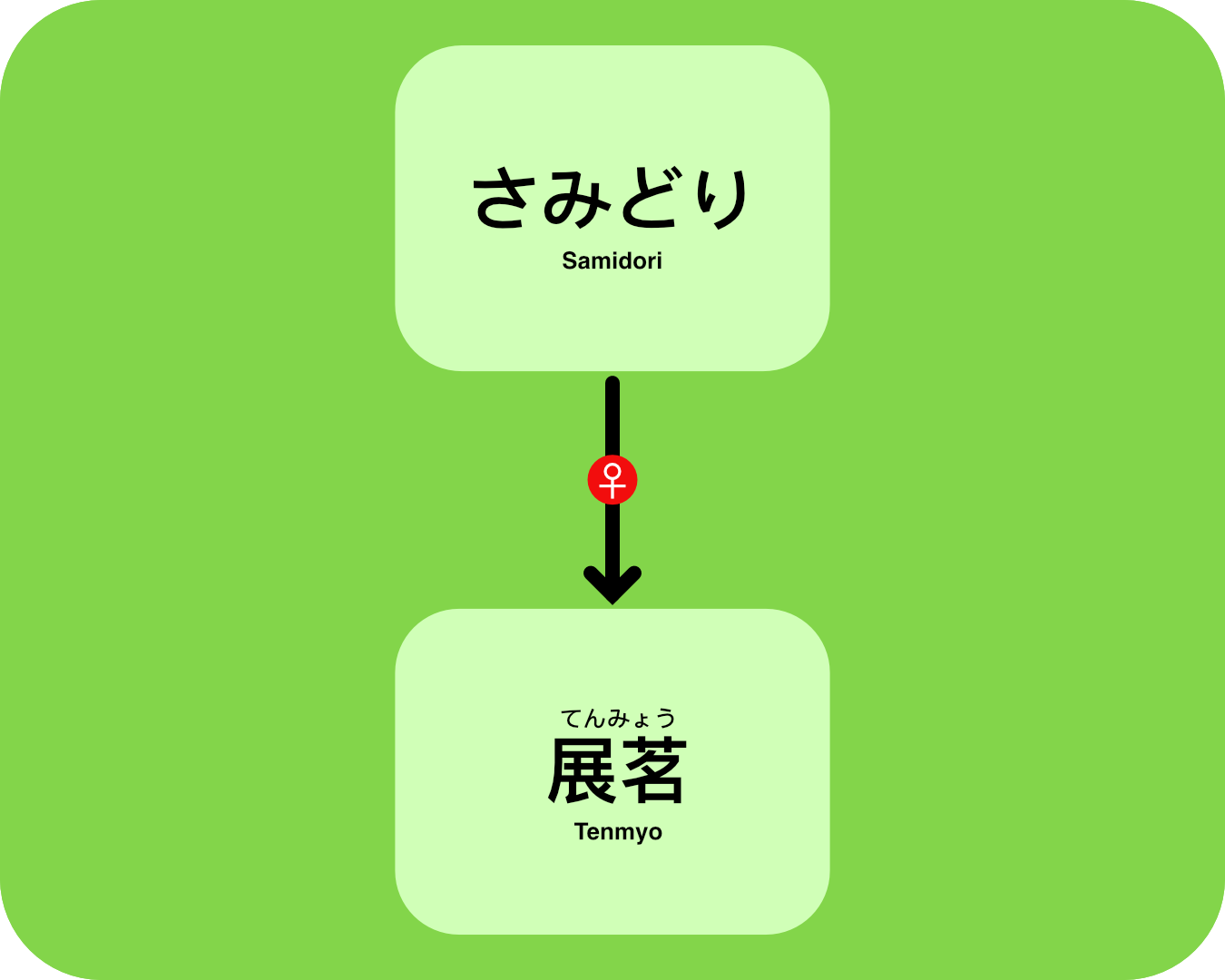
- Selected from a natural crossing of Samidori[1]
History
Tenmyo[2] is a Tencha cultivar selected and developed from a natural pollination of Samidori. It is also suited for Gyokuro cultivation. It was bred by the Kyoto Prefectural Tea Research Institute in Uji, seeds were collected in 1975, and selection started in 1977. Comparative trials began in 1979, and field adaptability trials began in 1993. After the study, registration was applied for in 2004, and it was finally registered under the Seed and Seedling Act in February 2006.
The same year, it was added to the list of recommended cultivars for the prefecture together with the jointly developed Houshun, which was also selected from a natural pollination of Samidori in the same round of development, with strain name 53-7 for Houshun and 53-38 for Tenmyo. It was bred for tencha production and machine harvesting while maintaining high quality.
Tenmyo has a few interesting traits that might shed light on its pollen parent. First, a 2021 SSR[3] marker study found that the probable pollen parent might be Asahi, as there is no mismatch in their SSR markers. This is not the case for Houshun, whose probable pollen parent is Rokurou[4] by the same SSR markers. This clearly shows how open pollination can be influenced by very different trees, even if the selected seedlings come from a single isolated one.
Another part that would support the theory that Asahi is the pollen parent for Tenmyo, although much less reliable, is that, according to the same study, Samidori and Asahi were planted next to each other in the institute fields, with the expectation that the traits of quality tencha of both parents would be passed to the resulting offspring, this is unpublished information. This planting method is one of the techniques used in tea breeding, and at least the SSR marker study seems to support the hypothesis that Asahi is indeed the pollen parent of Tenmyo.
Tenmyo was registered in 2006 under registration number 14535, with a 40-year protection period. The cultivation of Tenmyo seems fairly limited, with only 8.1 ha reported as of 2024, stable since 2015, when the reported area was 6.3ha. The cultivation area is unlikely to expand quickly.
Regulations on Tenmyo cultivation use plant variety protection rights and restrict cultivation to Kyoto Prefecture. However, seedlings can be produced through self-propagation from plants with clearly defined provenance, and no fees or royalties apply to their use. You may not transfer those seedlings to any third party, and any unused extras must be destroyed. Lastly, you are required to collaborate with any prefecture-related survey on self-propagation of this cultivar.
Characteristics
Tenmyo has an upright habit with vigorous growth and moderate spread, which improves once the plant is fully established. Its canopy thickness is also considered medium. Its bud break and harvest are about 1 to 2 days later than Yabukita, which makes Tenmyo a mid-season cultivar, its bud break is about 4 days later than Samidori and its yields are high. New cuttings root better than Samidori and show slightly stronger vigour.
In terms of disease resistance, it is susceptible to anthracnose and moderately susceptible to ring spot, so control measures are needed in areas prone to these diseases.
Its buds are uniform in size and grow upright, which makes machine harvesting much easier, one of the objectives of the breeding strategy for this cultivar. The shoots are slightly low in number, with a slightly long length and a high 100-bud weight. The number of branches per shoot is low, with slightly long internodes.
Because a good yield depends on heavy buds, it is recommended to trim the bush properly to ensure the right number of shoots are grown for harvest. New leaves are elliptical, slightly large, and thin. The new leaves are green, highly glossy, and slightly soft, similar to Samidori.
The finished leaves as tencha are good, with an excellent aroma and taste. It handles long periods of shading well, which also improves its colour and develops a good shaded aroma [5]. Mature leaves are elliptical and slightly large, green, and moderately wrinkled on the leaf surface, with wavy edges.
The finished product tends to be darker than other cultivars, so additional research has examined how to adjust this during processing. Those studies reported that quality improved when the tencha oven temperature was dropped slightly compared to conventional settings. Tenmyo has higher moisture content than other cultivars, at a reported 521% versus the usual 427% of Yabukita and 485% of Samidori, so controlled drying becomes more important to avoid drying too much too quickly and to preserve tencha quality. It is also recommended to start shading earlier than usual and increase the period of intense shading (double-layer shading) at the end, slightly above the usual 20-23 days mark, to about 30 days.
The time spent under light shading (single-layer shading) would be about 6 days, and the time under intense shading would be slightly higher at 24 days. This improved the colour of the finished product, most likely because it entered the stage where chlorophyll content starts dropping, although the report did not provide any data on it. This improved aroma and resulted in a brighter colour, with its quality evaluation being about the same as Samidori and Asahi.
The report also showed that, compared to the conventional method and timing, this early shading produced a 20 to 30% lower yield, and that Tenmyo's shoots and young leaves harden relatively quickly compared to other cultivars, so the harvest window is shorter. The resulting higher-quality product also generated extra income from auction prices. However, the current market may be different, and I could not find more recent data.
References
Kubo, Nakao, et al. “Parentage Analysis of Tea Cultivars in Japan Based on Simple Sequence Repeat Markers.” Breeding Science, vol. 71, no. 5, 2021, pp. 594–600. https://doi.org/10.1270/jsbbs.20156.
荻安彦, et al. 機械摘みにも適する良質・多収てん茶用新品種候補「53-38」. 京都府立茶業研究所, www.pref.kyoto.jp/chaken/documents/1325640649242.pdf. Accessed 14 Nov. 2026.
京都府農林水産技術センター茶業研究所. “宇治品種について” . 京都府ホームページ, 京都府, 30 Aug. 2022, www.pref.kyoto.jp/chaken/mame_ujihinnshu.html. Accessed 14 Nov. 2026.
京都府農林水産技術センター茶業研究所. 乾燥条件の改良により新品種「展茗」の色沢(色合い)を改善. 京都府, www.pref.kyoto.jp/chaken/documents/h28temyoukannsoujouken.pdf. Accessed 14 Nov. 2026.
京都府農林水産技術センター茶業研究所. 優良品種の育成と普及:育種. 京都府, www.pref.kyoto.jp/chaken/documents/3-1_breeding.pdf. Accessed 14 Nov. 2026.
京都府農林水産技術センター茶業研究所. “新品種‘鳳春(ほうしゅん)、展茗(てんみょう)’について”. 京都府ホームページ, 京都府, 7 Jan. 2013, www.pref.kyoto.jp/chaken/seika_hou-ten.html. Accessed 14 Nov. 2026.
京都府農林水産技術センター茶業研究所. 「展茗(てんみょう)」の黒みを抑える被覆方法の確立. 京都府, www.pref.kyoto.jp/nosoken/outcome/documents/28-06.pdf. Accessed 14 Nov. 2026.
京都府農林水産部農産課. “京都府産茶の生産・流通状況等に関する資料(旧京都府茶業統計)”. 京都府ホームページ, 京都府, 29 May 2026, www.pref.kyoto.jp/nosan/chagyotokei.html. Accessed 14 Nov. 2026.
京都府農林水産部農産課. 種苗法改正に伴う京都府の登録品種に関わる方針をお知らせします:令和4年4月1日以降の自家増殖について. 京都府, 2025, www.pref.kyoto.jp/nosan/documents/jikazousyoku_tirashi.pdf. Accessed 14 Nov. 2026.
京都府農林水産部農産課. 令和7年度京都府産茶の生産・流通状況等に関する資料(旧京都府茶業統計). 京都府, www.pref.kyoto.jp/nosan/documents/r7chachosa1.pdf. Accessed 14 Nov. 2026.
茶の品種. 2nd ed., 静岡県茶業会議所, 2019, shizuoka-cha.com/index.php/books.
“登録品種データベース:展茗(登録番号14535)”. 品種登録迅速化総合電子化システム, 農林水産省, www.hinshu2.maff.go.jp/vips/cmm/apCMM112.aspx?TOUROKU_NO=14535&LANGUAGE=Japanese. Accessed 14 Nov. 2026.