
Saeakari さえあかり
Saeakari is an early-maturing Japanese tea cultivar developed in 1989 and registered in 2012 after a 21-year breeding period. This cultivar is gaining significant traction as a potential replacement for aging Yabukita fields due to its exceptional disease resistance to anthracnose and ring spot, earlier harvest, higher yields, and superior summer tea quality with minimal astringency. Saeakari combines the bright-green colour leaves, excellent replanting success rates and easier disease management, making it suitable for cultivation in regions where one of its parents, Saemidori, is not suitable. Saeakari, is increasingly popular among farmers seeking alternatives to Yabukita monoculture.
Lineage
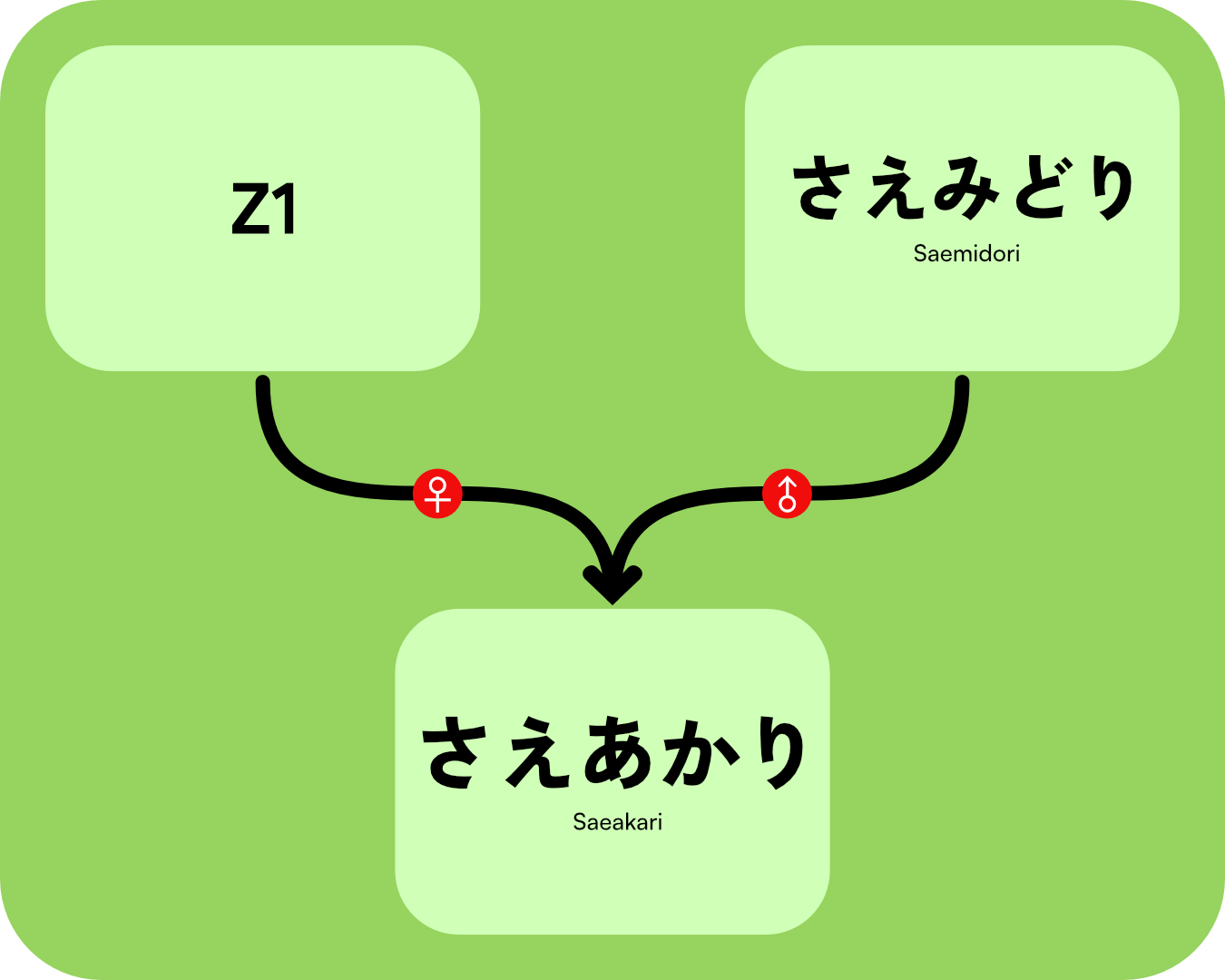
- Z1 ♀
- Saemidori ♂
History
Saeakari was crossbred in 1989 by the National Agriculture and Food Research Organization, NARO. The flower component was Z1, a high-yielding, high-resistant cultivar, and Saemidori, an early flushing cultivar resistant to anthracnose and a highly regarded cultivar for its quality as the pollen component. The application for cultivar registration was filed on April 8, 2010, with application number 24796. The registration application was announced on July 21, 2010. According to a paper regarding the cultivar, on March 28, 2011, it was officially registered as cultivar No.55. This data conflicts with the NARO press release and the information on the Ministry of Agriculture, Forestry, and Fisheries database of cultivars, where the registration date is November 14, 2012. The registration number on the database is 22070.
The origin of the name comes in part from its inheritance of the bright colour characteristics of Saemidori. While also being better suited for the summer weather and harvest. Saeakari is an early-maturing green tea cultivar with high quality and yields for both spring and summer harvest.
Saeakari is projected to become a popular cultivar as more Yabukita fields age and start to be replanted. While many developed cultivars aim to replace Yabukita, Saeakari seems to be one of the cultivars that is gaining most traction in that regard, certainly a cultivar to keep an eye in the future. This is also reinforced in a study about the adoption trend of Saeakari as a new cultivar in the Nagasaki prefecture. While the Yabukita planted area is decreasing, together with an overall downward trend in tea cultivation, Saeakari adoption is growing fast, and it is the first cultivar being planted in the prefecture. That study also explores the possibility of Saeakari taking over Yabukita in the future.
In addition, when replanting Yabukita cases of poor live-planting rate initial growth and delayed maturation have been observed, which becomes a problem for the farmer. Saeakari's behaviour, under those circumstances, is different, not only is it more resistant to pests, which helps with disease control, but also the cost of replanting and subsequent management is easier. That means that the farmer can restore income from replanted fields earlier. In Mie and Nagasaki, Saeakari was rated as promising, with five other prefectures rating it as somewhat promising with a 4 out of 5 on the usual scale used in cultivar reports papers.
The timeline of breeding the Saeakari cultivar spans 21 years. Saeakari was bred in 1989 from the seed component of Z1, for its high vigour, moderate resistance to anthracnose and root rot resistance as the flower component. The pollen component of Saeakari was from Saemidori, a cultivar with excellent tea production quality. The release paper of Saeakari includes a detailed timeline of the breeding process, summarised below.
The selection of the crossings was carried out from 1992 to 1996, and the strain that would be Saekari, later on, was selected out of that selection as an F1 Hybrid[1] with the number 71513. These initial tests include results like growth, harvesting time, disease resistance, and tea quality. This test concluded in 1997 with its selection from the nursery and moved to the next round of tests.
From 1998 to 2005, it was tested under the name "Makura Line 46-11" in Group 46 of the Nutrient System Comparison Test, from 2002 it was selected and tested as "Makurazaki No. 30" in Group 9 of the Adaptability Test due to its exceptional suitability for cultivation and processing. Strain adaptability tests were performed in several prefectures like Mie, Kyoto, Kochi, Shizuoka, and Kagoshima. Some others joined later in those tests, so the amount of data collected differs in some years.
Saeakari can be harvested 3 to 4 days earlier than Yabukita, making it a suitable cultivar to grow alongside to spread the harvesting periods and avoid overloading the processing factories. It can be grown in climates south of Shizuoka prefecture, and it has stronger resistance to diseases, which opens up cultivation in areas where Saemidori was not suited well.
The results of the trials in 2009 concluded that it is a slightly early cultivar with excellent disease resistance, yield and tea quality. It was named Saeakari and an application for cultivar registration was filed on 8 April 2010 with application No.24796, the application was published on 21 July 2010. It was registered as Saeakari as tea cultivar No.55 on 28 March 2011 under the MAFF cultivar registry.
Characteristics
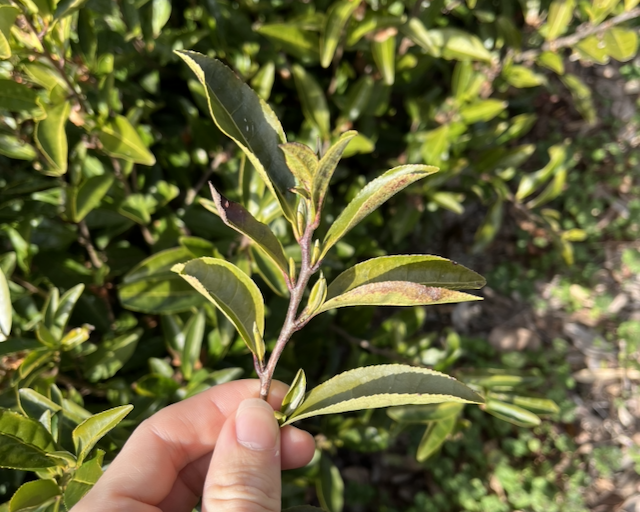
Saeakari presents a slightly open form, with vigorous growth and large stature. The branches are somewhat more numerous, with the internodes slightly longer than those of Yabukita, and their thickness is similar to that of Yabukita. The new leaves are oblong, similar in size and thickness to Saemidori, although wider than Saemidori and Yabukita, and bright green. The leaf has some lustre, and the leaf texture is soft, the density of Thricomes on the underside of new leaves is higher and longer than that of Saemidori and Yabukita cultivars. The adult leaves are oblong-oval in shape, and green but lighter and slightly more glossy than those of Yabukita.
Saeakari is, both resistant to anthracnose and ring spot disease, with a harvesting period of 3 to 4 days earlier than Yabukita and 3 to 4 days later than the early flushing cultivar Saemidori. On summer and autumn harvest, the harvesting period can be up to 8 days earlier than Yabukita. The yield of Saeakari is higher than both Yabukita and Saemidori, with the quality of the spring tea being the same as Saemidori and the quality of both second and third harvest is superior to Saemidori. At the same time, the Saeakari harvest falls between Saemidori and Yabukita, with a margin of 3 to 4 days for both.
Yabukita is susceptible to both anthracnose and ring spot disease, while Saemidori is susceptible to frost damage. At the same time, a topic mentioned in many other cultivar release papers and research on tea cultivars states that the monoculture of Yabukita and the obsolescence of the fields planted in the 60s and 70s is becoming an increasing problem. The market also values highly early-growing, high-quality cultivars like Saemidori, which, generally, ranks the highest in tea auction prices. Lastly, the increased demand for RTD[2] drinks puts more pressure on a more stable, higher yield production for summer leaf teas.
As for other diseases, Saeakari's resistance to red blight is slightly lower than Yabukita but stronger than Saemidori. Cold resistance for fissure-type frost damage is also higher than Saemidori, which opens up more areas of cultivation, although it is still weaker than the results reported for Yabukita. Red blight resistance of Saeakari in the growing area was assessed visually by treating 20 cut branches at -10 to -14 °C for 2 hours in mid-January and leaving them at room temperature for 2 days, after which the degree of cold injury was determined visually. Based on these results, Saeakari has cold resistance comparable to Yabukita and can be grown in areas where Yabukita can be grown. However, due to its slightly early maturing characteristics, it is likely to be affected by late frost damage in cold regions and is suitable for cultivation in warm regions south of Shizuoka Prefecture.
Saeakari's cold hardiness is similar to that of Yabukita, and it can be grown in tea-growing regions throughout Japan. However, as it is a slightly early maturing variety, it is best grown in warmer areas south of Shizuoka Prefecture.
For glutinous blight, commonly referred to as mochi disease in Japan, a test carried out in Shizuoka Prefecture. The test used the Kurasawa cultivar, which is susceptible to it, Yabukita, which is slightly weak to it and Okuhikari, which is partially resistant to it as control cultivars. The results indicated that Saeakari was more susceptible to glutinous blight than Yabukita, but less susceptible than Kurasawa, and its resistance to glutinous blight was judged slightly weak. The release reports state that control is necessary in mid-mountainous areas.
The characteristics of the first harvested shoots of Saeakari tea were larger in both bud weight and number of buds than those of Saemidori and Yabukita, and the leaf colour was superior. Tea leaves present a dark green colour and the brew quality shows a bright colour on both leaf and watercolour, with an aroma similar to that of Saemidori. Excellent summer tea quality. The fragrance is similar to that of the pollen parent, Saemidori, and sometimes has a mild, sweet, steamed sweet potato-like aroma. The flavour has a strong presence of umami.
Interestingly, a study performed tests on the tea quality of Kamairicha in Kumamoto and Miyazaki prefectures. The report show that the quality of Saeakari tea production was superior to Yabukita in Kumamoto Prefecture, with a high overall evaluation, and slightly inferior to Yabukita in Miyazaki Prefecture. These results confirmed that Saeakari is also as suitable for Kamairicha tea as Yabukita.
The leaf colour of Saeakari's sprouts in the field is bright green. The leaf colour is also bright after the second tea, which is reflected in the appearance of the tea when it is made, with splendid colour and gloss, and the shape is fine and narrow because the leaves are tender. The aroma and flavour of Yabukita and other teas are often regarded as low because of the peculiar smell and astringency of summer teas from the second tea stage onwards. Saeakari" has little smell of summer tea after the second tea, and maintains a good flavour with little astringency.
The chemical composition of Saeakari was also studied, the amino-acid content of Saeakari tended to be higher than that of Yabukita and the tannin content was lower. The trend was more pronounced for the summer tea, with higher free amino acid content and lower tannin content than Yabukita in all locations where the chemical content of the summer tea was investigated.
The reported average survival rate of Saeakari cuttings, was 85.4%, with good growth and uniformity of the propagated cuttings. The average values for survival percentage, height, and growth reported for the second year of planting were similar to those of Yabukita, with good vigour. In the final year of the trial, the values for height and growth were greater than those of Yabukita. Those were equivalent to Yutakamidori, another Sencha cultivar used in the tests, notably the vigour of the cuttings was reported to be greater than Yutakamidori.
Early cultivars such as Kanayamadori, registered as Tea No.30 in 1970, and Saemidori and late ones such as Okumidori and Harumidori, which have high-quality, high-yielding characteristics, contribute to the decentralisation of the picking season. However, the task of breeding disease-resistant green tea cultivars has remained a challenge.
(Takeda 2007), listed Yamatomidori (Nara Prefecture), Minamikaori (Miyazaki Prefecture) and Minamisayaka (Miyazaki Prefecture) as representative cultivars resistant to anthracnose and root rot. In addition, Harunonagori, recently bred by Miyazaki Prefecture, is also resistant to anthracnose and ring spots. However, these are later-harvested than Yabukita, and no practical early to mid-season disease-resistant cultivars have been bred.
Some of Saeakari's main characteristics are a slightly early maturity and resistance to anthracnose and ring blight. Therefore, unlike Yabukita, this variety does not require chemical control against these diseases, reducing fungicide costs and spraying labour. Existing cultivars bred by the Vegetable and Tea Research Institute that are more resistant to anthracnose than Yabukita include Kanayamidori and Meiryoku as an example.
However, when these cultivars were planted next to the anthracnose susceptible cultivars like Sayamakaori and Okumidori in the growing area, a significant increase in anthracnose incidence was observed on both Kanayamidori and Meiryoku. In contrast, when Saeakari was planted next to Sayamakaori, anthracnose disease was hardly observed, confirming its strong anthracnose resistance.
References
Katrina Wild. ´Japanese Tea Cultivars : A Short Guide´, https://obubutea.com/shop/uncategorized/japanese-tea-cultivars-a-short-guide/
品種登録迅速化総合電子化システム. https://www.hinshu2.maff.go.jp/vips/cmm/apCMM112.aspx?TOUROKU_NO=22070&LANGUAGE=Japanese.
さえあかり | 農研機構. https://www.naro.go.jp/collab/breed/0200/0206/001812.html.
吉田克志, et al. 炭疽病・輪斑病複合抵抗性のやや早生緑茶用品種‘さえあかり’の育成. 独立行政法人 農業・食品産業技術総合研究機構, 28 Feb. 2012. DOI.org (CSL JSON), https://doi.org/10.24514/00001732.
Cultivar handbook published by NARO https://www.naro.go.jp/publicity_report/publication/files/cha_hinshu_handbook06.pdf
Dissemination of the new green tea variety 'Saeakari' as an alternative to 'Yabukita' in Nagasaki Prefecture.
Nagasaki Prefectural Department of Agriculture and Forestry Kazutoyo Ikeshita
https://www.jataff.or.jp/books/order/journal/yousi/JATAFFj0610.htm
Last update: 2025 October 25th
Added footnotes, top summary, improved overall text structure, and removed redundancies.