
Ryofu りょうふう
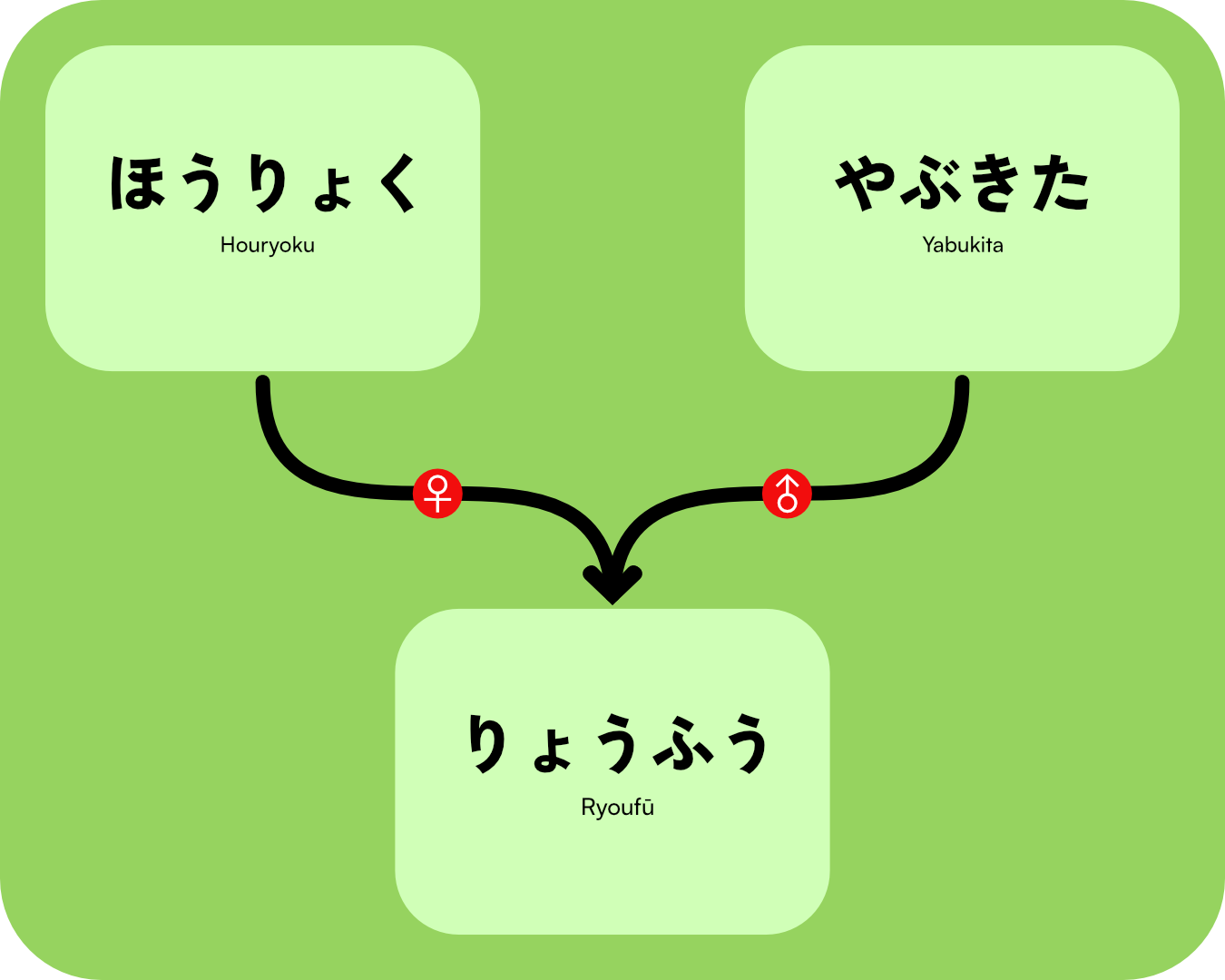
Ryofu is a mid-to-late harvesting sencha cultivar developed in 1972 from a cross between Houryoku (an unregistered assamica-derived cultivar) and Yabukita, registered in 1997.
Lineage
Ryofu is a mid-to-late harvesting sencha cultivar developed in 1972 from a cross between Houryoku (an unregistered assamica-derived cultivar) and Yabukita, registered in 1997. Named "cool breeze," Ryofu buds about 4 days after Yabukita and offers superior cold and disease resistance, excellent propagation rates, and higher yields across all three harvests compared to Yabukita. The cultivar produces quality sencha with notably better leaf colour in summer and autumn harvests, received high desirability scores from multiple prefectures.
History
Ryofu, a sencha cultivar, was crossed in 1972 at Kanaya Tea Research Centre. It was created by crossing Houryoku for the flower component and Yabukita for the pollen. Released to the public in 1997, it was registered as sencha cultivar No. 45 in the MAFF registry. In 2001, it also registered under the seed and seedlings registrar with registration number 9204. Its name means “cool breeze”[3].
Houryoku, Ryofu’s flower component, originates from a seedling selection made from Tada Motokichi’s material introduced from India. Developed as part of the Shizuoka 4000 series, Houryoku was designated with number 4018. It was chosen as a cultivar from the assamica variety suitable for green tea at the Shizuoka Kanaya National Research Centre in 1943. Despite its further development in 1956, Houryoku was never registered.
Ryofu’s development began after seed collection in 1973. Field selection trials were conducted until 1979 with the number 47-436. From 1980, it was propagated again and tested in a nursery. Between 1980 and 1987, its tea production characteristics were evaluated with name F1-139. From 1988 to 1994, with the name Kanaya No. 17, it underwent tests for regional adaptability, disease resistance and production across 13 prefectures. This included areas from Ibaraki’s northern tea production limit down to Kumamoto and Kagoshima.
In 1996, this cultivar previous research studies demonstrated excellent cold and disease resistance and was deemed suitable for tea production with its mid-late growing characteristics. Consequently, it was considered by the Committee examining potential new cultivars. Revised and accepted by the Tea Industry Testing and Research Promotion Council in 1997, the process for registering it with the MAFF began that same year. It’s available from licensed nurseries and is used beyond Japan.
Characteristics
Ryofu is a sencha cultivar known for its mid- to late-harvesting characteristics, cold and disease resistance, and high-quality sencha tea. It roots well and propagates easily in nurseries with a reported 90% survival rate, though some regional exceptions exist. The tree’s growth is good for the first three years, developing a tall shape and stretched root stock. Its growth behaviour mirrors Yabukita, with similar growth timings and slightly more branches. Survival from nursery to field is consistently high, with a 100% rate reported in almost all testing regions.
Ryofu is a cultivar resistant to cold and red blight, outperforming Yabukita. Its moderate resistance to anthracnose, compared to Yabukita, generally yields better results and is slightly less resistant than Kanayamidori[4], another moderately resistant cultivar. Cold damage was only observed in a few testing sites and surprisingly occurred outside northern areas like Ibaraki. While Ryofu is stronger than Yabukita against the mochi disease, it remains susceptible in poorly ventilated and humid environments and often appears after heavy rainfall periods.
Budding occurs around the same time as Kanayamidori, averaging four days after Yabukita. This places Ryofu in the mid-late budding cultivar category. The harvesting period is approximately two to three days after Yabukita. Developing late-growing cultivars helps spread out harvesting times, preventing overload at processing factories and making better use of labour which is seasonal and in short supply.
Ryofu’s yield is comparable to Yabukita’s in its first harvestable year but surpasses it in subsequent years. Furthermore, Ryofu yields more in its first, second and third harvests than Yabukita. The Ryofu release report provides these values in harvested grams per square metre (g/m2) for comparison. For instance, the average harvested amount in spring was 482g/m2 for Yabukita and 533g/m2 for Ryofu. Then 261g/m2 and 369g/m2 in summer and finally 188g/m2 and 236g/m2 in autumn respectively. Kanayamidori, once again, matched Ryofu’s yield but produced slightly more harvested leaves in spring. This difference might be due to the similar number of buds but Ryofu’s buds being longer.
The leaves of the Ryofu variety share a similar shape and appearance to those of Yabukita in terms of bud weight, length and number. However an increase in branching resulting in a thicker canopy could also explain the slightly higher yield. Ryofu leaves are yellowish-green, long and oval-shaped with a medium size and a non-glossy surface. One interesting feature is the improved leaf colour in summer and autumn compared to Yabukita and other varieties which can develop reddish or brown hues during these times.
The brewed tea’s quality was generally good, comparable to Yabukita. Its appearance was also similar to Yabukita though slightly less well-formed. The tea was clear with a good colour and was evaluated better compared to both Yabukita and Sayamakaori during the Summer and Autumn harvests.
One interesting data point introduced in release reports for cultivars was a desirability or preferability score. This score reflects the prefecture’s opinion on how desirable the cultivar’s traits would be in their region. For example, a great-tasting cultivar might receive a lower score due to poor rooting, making it unsuitable for certain prefectural soils. Ryofu received a perfect 5 out of 5 in Saga and Kumamoto prefectures while Kagoshima and Ibaraki were close behind with scores of 4.7 and 4 respectively.
References
“品種登録迅速化総合電子化システム.” _Maff.go.jp_, 2025, www.hinshu2.maff.go.jp/vips/cmm/apCMM112.aspx?TOUROKU_NO=9204&LANGUAGE=Japanese. Accessed 10 Jan. 2025.
Kondo Sadaaki, et al. “New Released Green Tea Cultivar ‘Ryofu.’” Chagyo Kenkyu Hokoku (Tea Research Journal), vol. 1999, no. 87, May 1999, pp. 21–38. DOI.org (Crossref), https://doi.org/10.5979/cha.1999.21.
小栁津 勤(2004):静岡県における茶品種普及への取組み.野菜茶業研究集報,1,79-108. https://agriknowledge.affrc.go.jp/RN/2010700196
“4006 アッサム系緑茶用激レア品種.” _天竜楽市_, 29 June 2018, tenryu-rakuichi.amebaownd.com/posts/4457466/. Accessed 10 Jan. 2025.
Last update: 2025 December 28th
Added footnotes, top summary, improved overall text structure, and removed redundancies.