
Okuyutaka おくゆたか
Okuyutaka, a mid-late growing sencha cultivar registered in 1983 at the Kanaya Tea Experiment Station, honours its parent Yutakamidori. It boasts significantly higher yields than Yabukita and demonstrates good cold resistance and low disease incidence. Its distinct flavour profile, stemming from its non-Yabukita lineage, offers a mild umami-rich taste. Okuyutaka is particularly suited for cultivation in southern areas from Shizuoka Prefecture, including mountainous regions where cold tolerance is crucial.
Lineage
History
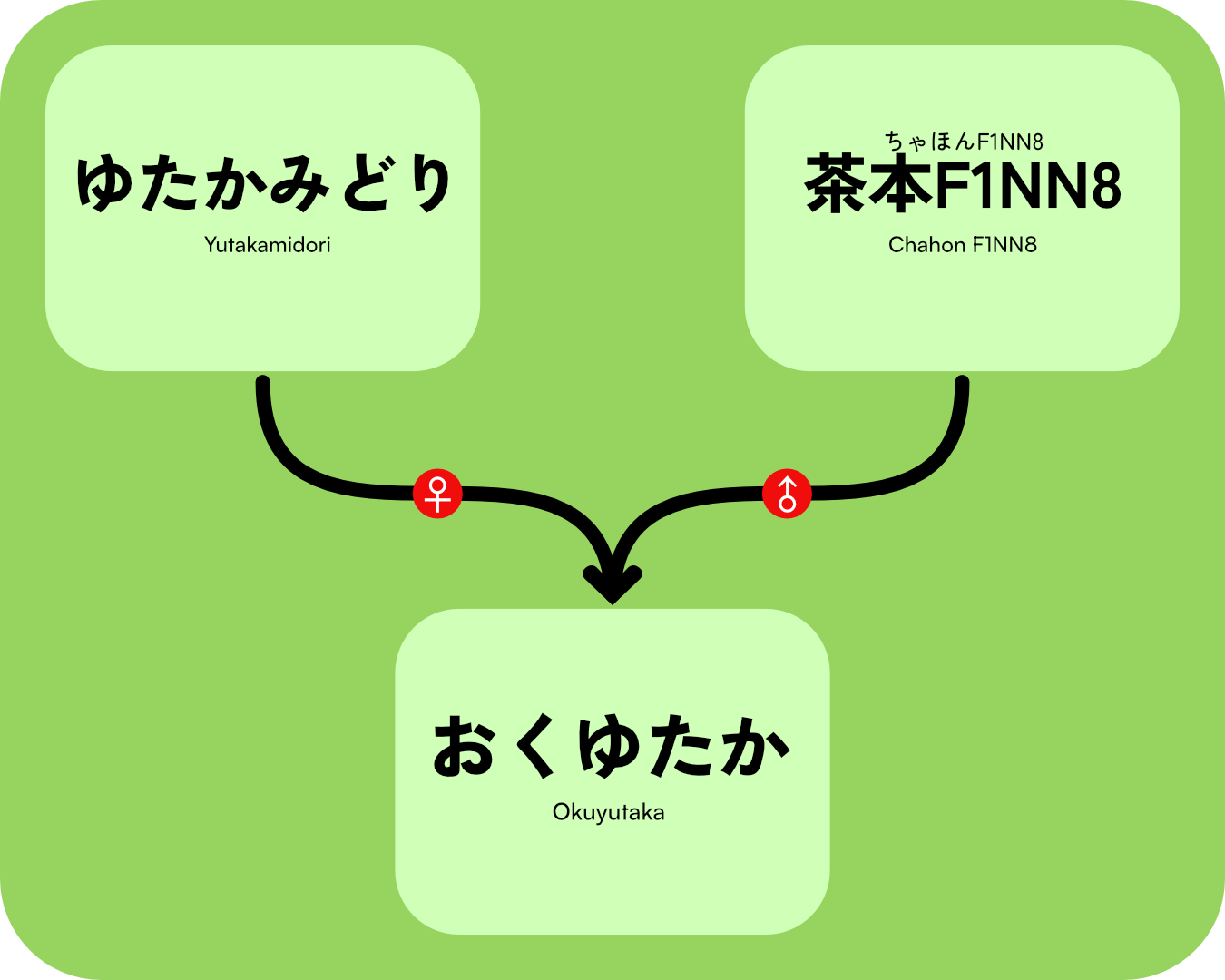
Okuyutaka is a sencha cultivar developed through a cross between Yutakamidori and Cha-Hon F1NN8 in 1983. Initially selected from seedlings at the Ministry of Agriculture Forestry and Fisheries Tokai Kinki Agricultural Experiment Station in 1958, the site is now the Ministry of Agriculture Forestry and Fisheries Tea Experiment Station in Kanaya. The name change occurred in the 1960s due to organisational changes within the Japanese ministries.
Yutakamidori, an unregistered cultivar, was selected from Asatsuyu seeds in 1949. It’s primarily grown in Kagoshima prefecture due to its poor cold-weather tolerance. Interestingly, it’s Japan’s second most grown tea cultivar. While still a distant second to the dominant Yabukita, Yutakamidori accounts for about 7% of all cultivated tea in Japan as of 2023 and roughly 26% of Kagoshima’s grown tea. This is close to the area of cultivated Yabukita in Kagoshima, which is around 30%. Cha-Hon F1NN8, the pollen component of Okuyutaka, is a cross between Tamamidori, a Zairai from Kyoto prefecture, and S6[3], a Zairai from Shizuoka.
The cross-pollination that would result in Okuyutaka was made in October 1958. The seeds from this crossing were harvested in 1959 and then transplanted in April 1960. Those seedlings were grown until 1963 and then underwent a selection process starting in 1964. In 1965, the seedling that would become Okuyutaka was selected for its characteristics in the initial round and then again in a second round in 1966. From 1967, it was named as Cha-Hon F1NN50. This strain underwent extensive testing against other strains selected for over a decade, culminating in 1976.
These included parallel tests common in cultivar breeding such as adaptability, characteristics, and propagation tests. In 1974, it was selected for wider adaptability testing and renamed Kanaya No. 3[4]. Starting in 1975, seedlings were distributed to various test sites for adaptability tests. These areas initially encompassed many prefectures across Japan and expanded annually, reaching a total of 19 sites by 1978.
Another test the strain underwent was the laceration-type frost damage test. This assesses the plant’s ability to endure and recover from cold-related injuries. It’s a commonly performed test at the Kagoshima Prefectural Tea Experiment Station and is mentioned in many other cultivars breeding release papers. Its importance lies in its role alongside the local adaptability test in determining recommended prefectures for growing the cultivar. Furthermore, it often influences whether the cultivar is promoted or dropped from the registration process, depending on its intended use and the regions where it’s meant to be planted.
Okuyutaka’s results were excellent until the final tests in 1982. This led to its submission as a sencha cultivar candidate at the Tea Industry Division Specialist General Review Meeting Breeding Subcommittee in February 1983. After revision, it was deemed suitable and an application for registration in the MAFF registry was submitted on the 26th of May 1983 as tea cultivar No. 34[5]. The name Okuyutaka honours its flower parent Yutakamidori, the oku component in the name signifies its mid-late growing characteristics.
Characteristics
Okuyutaka is a sencha cultivar with an intermediate shape, featuring well-developed stems and a high number of branches. Its rootstock is good and cuttings root well. The tea leaves are round, glossy with a slight wrinkle and are slightly thicker and smaller than those from Yabukita. These shoots are long and the new leaves are a slightly darker green. They’re glossier, thicker, and larger than Yabukita with a more elliptical shape. The 100-bud weight is heavier and the shoot count is medium. Seedlings are easy to grow with a high survival rate good root establishment and vigorous growth. In particular, 4-5 year-old seedlings outpace Yabukita in both growth and height.
The budding period follows Yabukita by about eight days and the first tea harvest by six. It grows slightly earlier than Okumidori and around the same time as Kanayamidori, making it a late-medium growing cultivar. Yields are higher than Yabukita, almost doubling in some test sites and seasons, and typically around 50% higher overall.
This cultivar is less susceptible to cold damage in the field compared to Yabukita, but is comparable in terms of severe damage. Anthracnose incidence is low, and no other disease weaknesses were observed during testing. Its relative cold resistance makes it a recommended cultivar for use south of the Tokai region, particularly in southern areas from Shizuoka and Gifu Prefectures.
Mountainous areas, where cold weather is a key consideration, are also included. The research paper mention Mie, Kyoto, Kochi, and Kumamoto prefectures as those likely to promote Okuyutaka as their cultivated varieties. Another advantage is its suitability for growing alongside Yabukita and its slightly earlier harvest compared to late cultivars like Okumidori. This allows for a more even distribution of labour.
The processed leaves are large but compact, giving them a good shape. They have a distinct aroma compared to other cultivars. The release report notes that since Okuyutaka does not share any Yabukita lineage in its ascendance, It does not share many characteristics found in other cultivars. The taste is mild and umami-rich, and interestingly, they have significantly higher amino acid levels, doubling the results of Yabukita in tests. Catechin content is slightly lower, but caffeine content is higher than Yabukita, creating a different cup balance.
The study found that many prefectures reported promising and even extremely promising results. This was particularly evident in southern areas like Kyushu and Kochi on Shikoku island.
References
農林水産省野菜・茶業試験場 [編]『茶業試験場研究報告』(19),農林水産省野菜・茶業試験場,1983-09. 国立国会図書館デジタルコレクション https://dl.ndl.go.jp/pid/2380194.
Last update: 2025 December 7th
Added footnotes, top summary, improved overall text structure, and removed redundancies.