
Minamisayaka みなみさやか
Minamisayaka is a sencha variety developed in Miyazaki in 1970 and registered in 1991. It has Assam and Caucasus genetic material. It buds around 4 days after Yabukita and harvests 1 day later. It is resistant to anthracnose and ring spot and often requires no chemical treatment for either. It yields as much as or more than Yabukita. The tea is deep in colour and high in amino acids. The aroma is strong with divisive opinions. It is suited to warmer areas and should generally be kept out of cold areas.
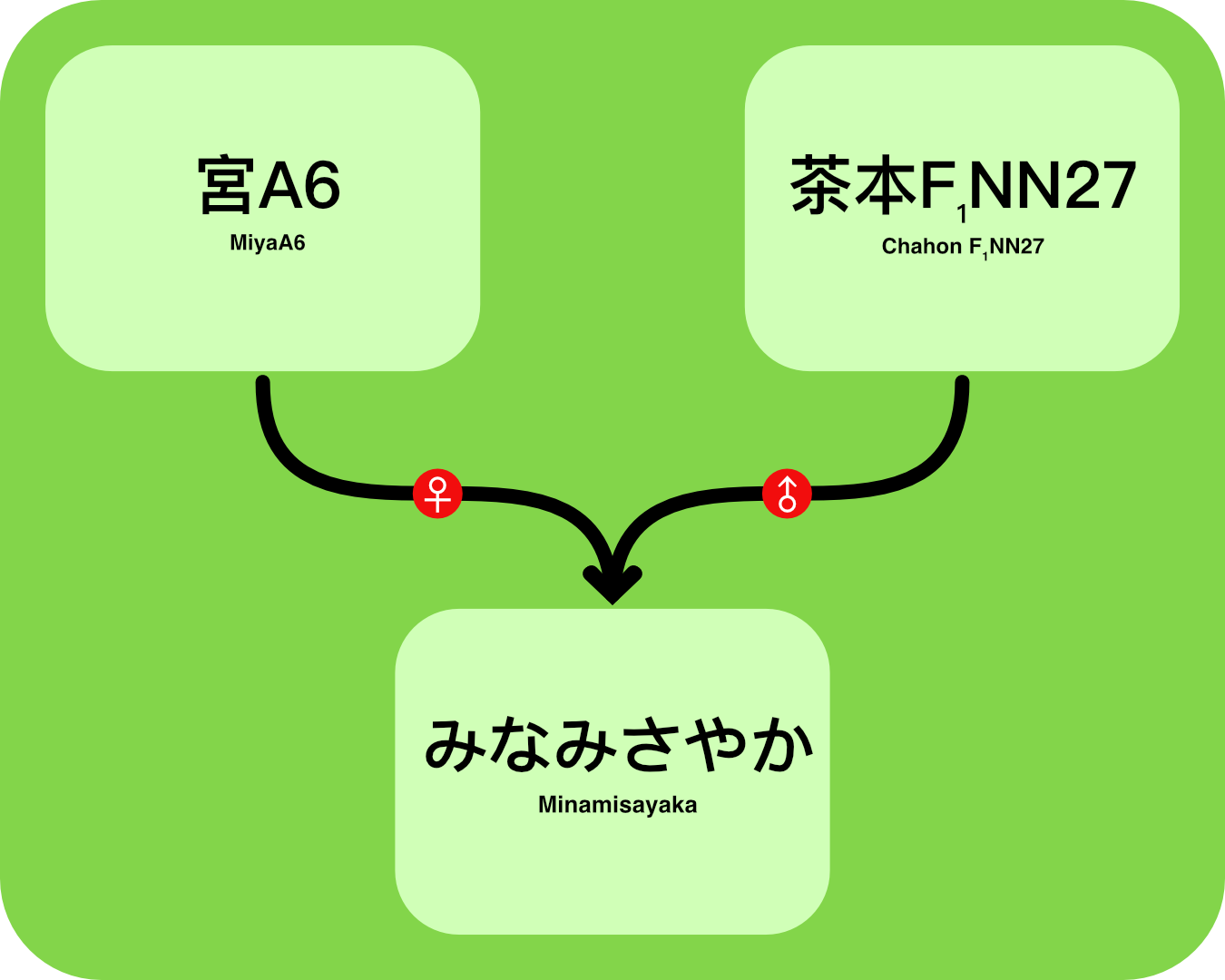
Lineage
♀: MiyaA6 宮A6[1]
♂: 茶本F1NN27[2]
History
Minamisayaka was crossed in 1970 at the Tea Branch of the Miyazaki Prefectural Agricultural Experiment Station to breed a high-quality, high-yield cultivar with cold and disease resistance. It was selected from a group of seedlings obtained by crossing Miya A6, a high-quality variety derived from Indian Assam and Russian Caucasus strains, particularly noted for its aroma, as the seed parent and ‘NN27 or 茶本F1NN27’, a cultivar with strong vigour, high yield and excellent growth habit, as the pollen parent.
Individual selection began in 1972, and in 1976 it underwent comparative trials under the strain name Mi77-01, where it was tested for yield, quality, and other characteristics. In 1984-1985, it was tested in Group 4 alongside other selections as the strain Miyazaki No. 9 and distributed to trial stations for adaptability and characteristic evaluation.
Based on trial results through 1990, the strain showed characteristics necessary for widespread adoption as a sencha cultivar suitable for warm climates. In February 1991, the Committee for the Review of Candidate New Tea Varieties reviewed it at the Conference for the Promotion of Vegetable and Tea Industry Research and Development in March of the same year. An application was submitted for registration with both the Ministry of Agriculture, Forestry and Fisheries registry and the seed and seedlings registry. It was registered as cultivar No. 42[3], named Minamisayaka, in June 1991 and registered as a seedling in March 1994. It was registered as a sencha cultivar suited to Japan's warm southwest region.
The name Minamisayaka [4] reflects its origin in Miyazaki and its suitability for warm climates, and suggests a refreshing aroma and flavour.
Characteristics
Minamisayaka is a mid-to-late budding and harvesting cultivar, with budding about 4 days later and harvesting about 1 day later. It has a moderately high yield, although the reported data relies on adaptability trials, as a specialised breeding method was adopted to shorten breeding time and there was almost no data from earlier years. It also has strong resistance to anthracnose and ring spot disease. The bush is upright and taller than Yabukita, with moderate spread and vigour, moderate branching from new shoots, and slightly longer internodes. The main trunk branches in the centre tend to be stronger and grow significantly more than the ones on the sides of the canopy.
The leaf canopy is considered slightly thick, with numerous uniform buds. The buds are slightly long, with a moderately high 100-bud weight count even if the number of shoots is a bit less. This makes Minamisayaka a bud-heavy cultivar. New leaves are oblong-elliptic, slightly large, and medium-thick. The leaves are dark green with a slight shine, and the underside has an evenly distributed coat of trichomes. Mature leaves, in contrast, are long and elliptical, with wrinkles and some waviness along the edges. New plants root well, and cuttings transplant well into the field. When seedling growth was compared with Yabukita plantings in their second year, Minamisayaka had greater stature and a similar spread. Younger bushes have moderate yield, and older ones slightly higher. Yields in both spring and summer were generally higher than Yabukita. Some other test sites reported yields similar to Yabukita.
In terms of resistance, it is strongly resistant to red blight and anthracnose, moderately resistant to blue blight, and resistant to spider mites. Minamisayaka also showed a low incidence of the fungal disease responsible for shoot blight and ring spot disease. In particular, the study suggests that chemical or other treatments for anthracnose may not be necessary, even in times or locations where it is prevalent. It is reported to have strong resistance to frost laceration, one of the breeding program's objectives. Additionally, frost damage to leaf tips during periods of severe cold is moderate to slightly high, similar to Yabukita.
Finished tea was reported excellent in appearance, shape and colour. The liquor was reported as excellent, with an above-average colour that is deep and vivid in both spring and summer harvests. This is further supported by higher average levels of amino acids, theanine, tannins, and caffeine from the chemical analysis. The aroma is also described as fragrant and strong, but it was divisive in the sensory evaluation. This may be because some aromas fall outside the usual Japanese green tea category, possibly influenced by the genetic expression of its foreign Assamica and Caucasus material. Quality evaluations showed that, in some prefectures, the tea was the same quality as, or higher than, high-grade Yabukita, while others showed a slightly lower evaluation in spring tea. Overall, summer tea consistently received good evaluations.
Minamisayaka is recommended for warm or temperate areas. In areas where diseases like ring spot are common, higher resistance can reduce the need for chemical applications. While it is resistant to some diseases, caution is advised in areas with powdery mildew and red rust. While it resists cold damage in some types, the report notes that it is best to avoid cold areas, as it is only moderately strong against blue blight. Moreover, to take full advantage of the bush's vigorous growth and high yield, it is recommended to plant with wide spacing in the usual double-row planting style. Because it tends to spread moderately, keep trimming relatively light to increase branching and support a slightly higher harvest of high-quality tea, due to Minamisayaka's bud-heavy tendency.
References
- 古野 鶴吉 et al. “煎茶用品種「みなみさやか」の育成” [The Breeding of the Sencha Cultivar “Minamisayaka”]. 宮崎県総合農業試験場研究報告 [Bulletin of the Miyazaki Agricultural Experiment Station], no. 31, Mar. 1997, pp. 40–50. AgriKnowledge, agriknowledge.affrc.go.jp/RN/2030551059.
- 九州農業研究 [Kyushu Agricultural Research], no. 62, May 2000, 九州農業試験研究機関協議会.
-“みなみさやか” [Minamisayaka]. 登録品種データベース [Registered Variety Database], 農林水産省, www.hinshu2.maff.go.jp/vips/cmm/apCMM112.aspx?TOUROKU_NO=3932&LANGUAGE=Japanese. Accessed 11 Oct. 2026. - 西澤 法聖. “球磨地域における茶新品種「みなみさやか」の生育特性” [Growth Characteristics of the New Tea Cultivar “Minamisayaka” in the Kuma Region]. 農業研究成果情報 [Agricultural Research Results Information], no. 426, Sept. 2009, 熊本県農林水産部, www.pref.kumamoto.jp/uploaded/attachment/101346.pdf.