
Koushun 香駿
Koushun is a mid-season sencha cultivar bred in Shizuoka from a 1970 cross of Kurasawa and Kanayamidori. It yields high, even when young, and resists anthracnose and cold about as well as Yabukita. Its herbal, cooling aroma is unlike that of other cultivars, making it a pioneer for aroma-driven and withered teas.
Lineage
History
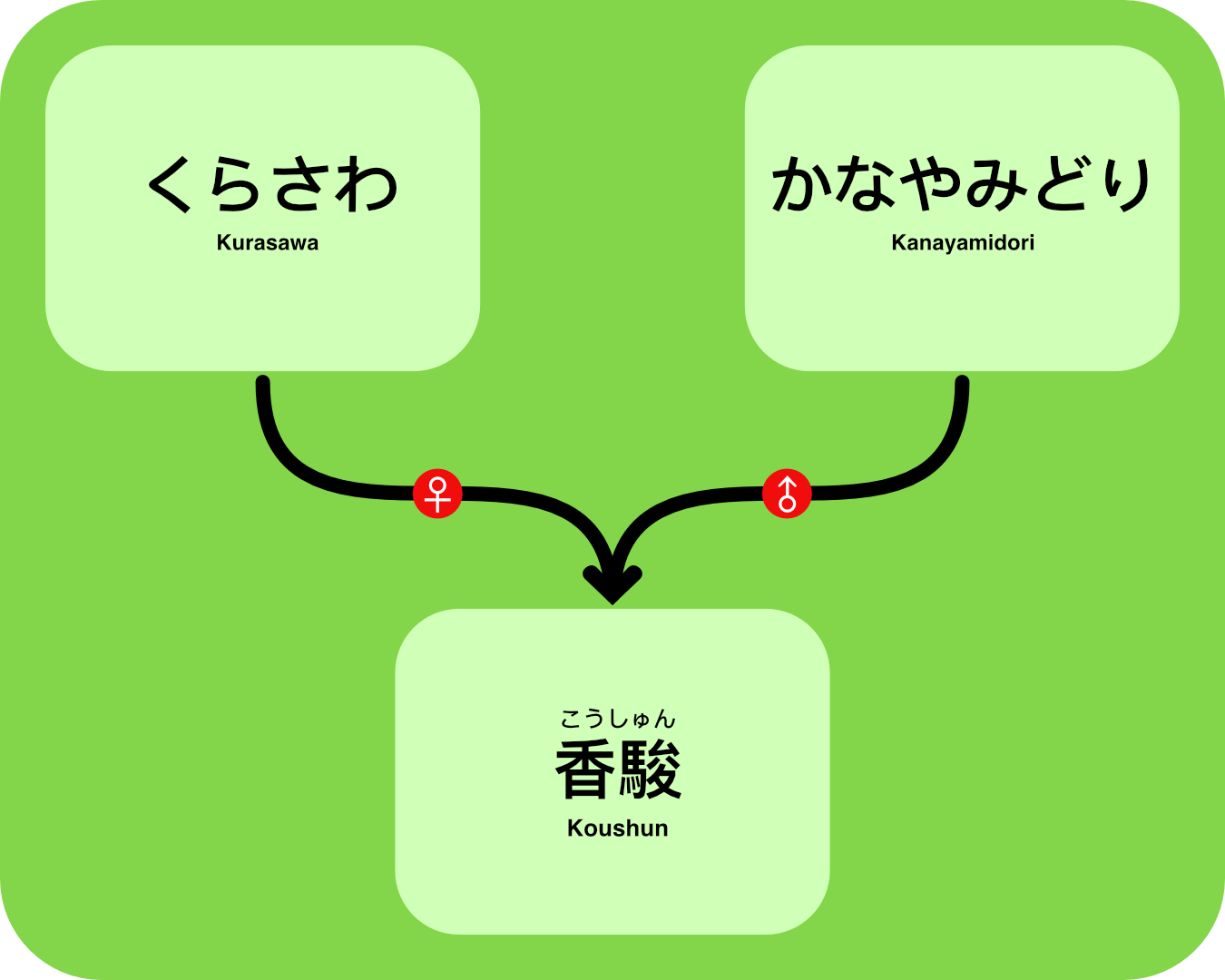
Koushun is a mid-season cultivar selected from seedlings derived from a cross of Kurasawa as the flower parent and Kanayamidori as the pollen parent in 1970 at the Shizuoka Prefectural Tea Research Centre[3]. This cultivar was developed in a context where cultivar cultivation in Shizuoka grew from 14% in 1965 to about 94% in 1996, mainly consisting of Yabukita. At the same time, in 1998 it was reported that around 63% of the fields were 20 years old or more. This means that all these fields were at about the half-life point, and a bunch of issues like outbreaks, concentration of the harvests and thus a decline in quality had been a recurring issue that needed to be addressed.
The same centre developed other cultivars in the same timeframe, like the early flushing Okuhikari[4] in 1985 and Sawamizuka[5] in 1992 and the late flushing Yamanoibuki[6] in 1996. The main objective was diversifying the homogenisation created by the over-reliance on Yabukita, keeping up with trends in the market, as well as lowering pressure on infrastructure development.
Koushun is a mid-season cultivar, with a distinctive aroma and flavour, markedly different from the mainstream Yabukita. It was bred to meet changing consumer demands and to support regions that wished to establish local brands.
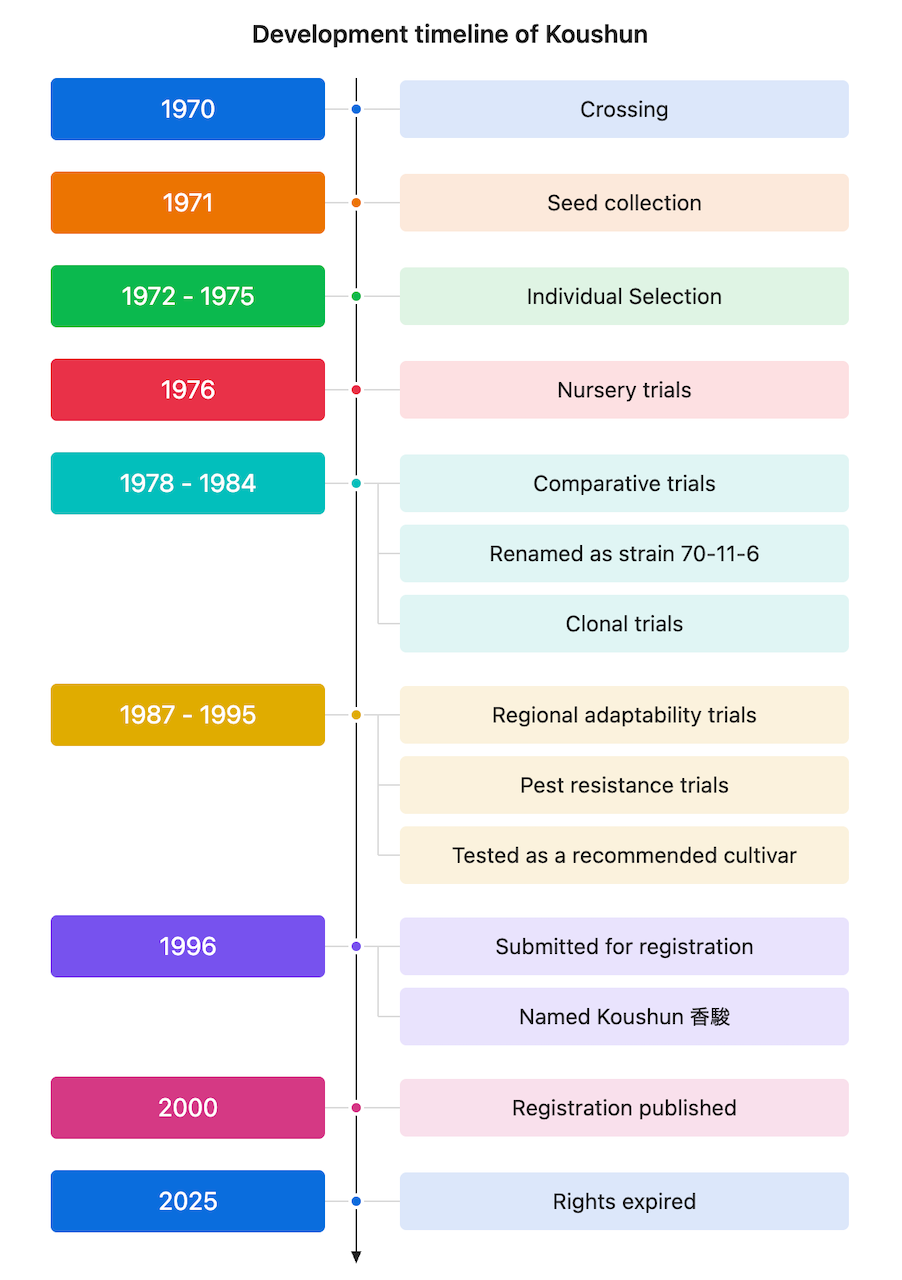
Koushun was selected from seedlings resulting from a cross in 1970 between Kurasawa and Kanayamidori. The resulting seeds were collected in 1971 and underwent individual selection from 1972 to 1975. Nursery trials began in 1976, with comparative trials from 1978 to 1984 under the strain name 70-11-6. After the studies reported high yields and excellent quality, it was further tested as a recommended cultivar from 1987 and subjected to regional adaptability and pest resistance tests.
With excellent results reported, a refreshing, long-lasting aroma, extremely high yields even during the juvenile stage, and uniform, numerous buds, it was submitted for registration under the Seed and Plant Variety Protection Act in November 1996 and named Koushun after a 25-year development phase. It was officially registered in June 2000 with registration number 8131.
The name is a play on words: the first kanji reflects the cultivar's distinctive aroma, and the second reflects the old name of the province where it was developed, Suruga[7], now Shizuoka.
One point where Koushun is important in the space of tea cultivar breeding in Japan is the field of aroma-driven teas. Koushun, together with some other aroma-driven cultivars like Shizu 7132 to mention one, slowly opened the door for white-tea sencha research and the market. Some more modern breeding cultivars build on the foundation laid out by Koushun's research. For example, the development of Yumesumika[8] registered in 2023, uses Koushun as the comparison cultivar for withered sencha[9] throughout its breeding development.
The plant's rights expired in June 2025, so we may start seeing it planted more widely, as no license or permit is required. Koushun does not benefit from the Seed and Seedlings Law amendment from summer 2026 by a narrow margin, which could have extended its protection rights by 10 years. Previously, under the 2020 policy, Koushun growing was limited to Shizuoka Prefecture, with self-propagation allowed with permission. With the loss of protection rights, those limits seem to have been lifted, as Shizuoka Prefecture is no longer listed in the protected document. The old listing is no longer available, so usage in other prefectures may have been allowed before 2020, but I could not find any document proving that.
Characteristics
The Koushun tree has an open, spreading habit with a wide canopy. Its vigour is moderate, with high yield potential compared to Yabukita, ranging from 101 to 134% in first-flush yield per 0.1 ha and from 117 to 141% yearly. The reported volumes of summer tea tended to be higher than those of spring, which is a major contributor to the high yields of Kouhsun.
In particular, the regional adaptability of 1987 was reported to be good in multiple environments. Growth, height, and canopy density were higher when compared to Yabukita, both in mountain sites and flatland sites.
Even when the plant is still young, yields are higher than Yabukita. The budding period is about 4 days earlier than Yabukita, with the same harvest period or a day later, making it a mid-season cultivar. Compared to Kurasawa in the same report, it can be harvested two days later. This vigorous growth, even when young, also requires extensive pruning management to maintain those high yields.
The buds develop well, with an extremely high number of buds, slightly longer bud length, and a moderate 100-bud weight. The number of unfolded leaves per shoot is also moderate, with new leaves that are dark green and oblong, and have moderate size, thickness, lustre, and texture. The internode length of the branches is similar to Yabukita.
Mature leaves become lanceolate in shape and medium in size. The leaves are slightly thick and dark green, with a moderate sheen. Mature leaves also tend to fold inwards and curl more pronouncedly than other cultivars.
Rooting from new cuttings in the first year is slightly inferior to Yabukita. In the second year, seedlings have more branches, and rooting is good, with excellent growth.
Koushun's cold hardiness against red blight and disease resistance to anthracnose are equivalent to or slightly stronger than Yabukita and Kurasawa. Frost incidence was lower, except in some cases where frost was generally pronounced in the test fields, such as in 1993. Anthracnose incidence was reported as low, comparable to or slightly lower than Yabukita and Kurasawa.
Spring tea quality is excellent, with slender leaves that can be tightly twisted. The fragrance is characteristic and not previously observed in other cultivars, reported as herbal with a refreshing, cooling aroma. As for chemical composition, amino acids are slightly low. The finished product is superior to Yabukita in all categories: colour, lustre, internal aroma, liquor colour, and flavour. In particular, for the reported values of the fields grown on mountainsides. The summer tea has a quality equivalent to, or slightly superior to, Yabukita, with the leaves still having good shaping.
A survey on preference for Koushun during its development revealed that 73% of the respondents could clearly identify Koushun through its particular taste and aroma. 60% of those respondents preferred it over Yabukita. Several later studies have looked into the use of Koushun's particular aroma as a suitable cultivar for Sencha, Kamairicha, Whitered Sencha, Tencha and even white leaf tea[10].
Koushun is a recommended cultivar to grow in Shizuoka. Its resistance allows it to be grown throughout the prefecture, and it is recommended for areas aiming to establish a regional brand. In particular, a 2023 growers' survey mentioned its good suitability for organic production, maintaining its high yields and a low incidence of anthracnose, together with some other cultivars like Tsuyuhikari, Meiryoku[11], and Yumewakaba[12].
References
References
中村順行. “香駿: これまでにない香味を持った中生品種.” お茶を楽しむホームページ O-CHA NET, 世界緑茶協会, www.o-cha.net/teacha/hinshu/koushun.html. Reprinted from 月刊「茶」, 静岡県茶業会議所. Accessed 21 Nov. 2026.
中村順行ほか. “香味豊かな煎茶用新品種‘香駿’.” 静岡県茶業試験場研究報告, no. 22, Sept. 1999, pp. 23–33. 農林水産省 農林水産技術会議事務局筑波産学連携支援センター, agriknowledge.affrc.go.jp/RN/2030600957.pdf.
茶の品種. 2nd ed., 静岡県茶業会議所, 2019, shizuoka-cha.com/index.php/books.
静岡県農林技術研究所 茶業研究センター. 萎凋で爽やかなスミレのような香りが際立つチャ新品種「ゆめすみか」. 2024, www.pref.shizuoka.jp/_res/projects/default_project/_page_/001/055/015/yumesumika_pamphlet_ver2.pdf.
鈴木康孝ほか. 茶の有機栽培で導入されている品種と有機栽培適性. 静岡県農林技術研究所 茶業研究センター, www.pref.shizuoka.jp/_res/projects/default_project/_page_/001/055/010/r5tya.pdf. Accessed 21 Nov. 2026.
鈴木康孝. “萎凋で爽やかなスミレのような香りが際立つチャ品種「ゆめすみか」.” あたらしい農業技術, no. 692, 静岡県経済産業部, 2023, www.pref.shizuoka.jp/_res/projects/default_project/_page_/001/054/612/692.pdf.
静岡県農林技術研究所 茶業研究センター. “静岡抹茶の生産拡大に向けたてん茶安定生産技術の開発.” あたらしい農業技術, no. 666, 静岡県経済産業部, 2020, www.pref.shizuoka.jp/_res/projects/default_project/_page_/001/054/612/666.pdf.
静岡県農林技術研究所 茶業研究センター. 静岡県茶奨励品種等におけるてん茶適性. 2019, www.pref.shizuoka.jp/_res/projects/default_project/_page_/001/044/307/r1-d.pdf.
静岡県農林技術研究所 茶業研究センター. 生葉保管による香りの強化. 明日に向けた茶の新技術, www.pref.shizuoka.jp/_res/projects/default_project/_page_/001/044/307/0311.pdf. Accessed 21 Nov. 2026.
静岡県農林技術研究所 茶業研究センター. 静岡県茶奨励品種における釜炒り茶適性と萎凋香発揚特性. 明日に向けた茶の新技術, www.pref.shizuoka.jp/_res/projects/default_project/_page_/001/044/307/019.pdf. Accessed 21 Nov. 2026.
鈴木康孝. “静岡県茶奨励品種の釜炒り茶適性と萎凋香発揚特性.” あたらしい農業技術, no. 521, 静岡県産業部, Aug. 2009, www.pref.shizuoka.jp/_res/projects/default_project/_page_/001/025/684/521kamairitya.pdf.
片井秀幸ほか. “強遮光処理が静岡県茶奨励品種の生葉収量,葉色,遊離アミノ酸含有量および荒茶品質に及ぼす影響.” 茶業研究報告, no. 133, 2022, pp. 1–13. J-STAGE, https://doi.org/10.5979/cha.2022.133_1.
白鳥克哉ほか. “「香り緑茶」の品種別の香気特性.” におい・かおり環境学会誌, vol. 53, no. 5, 2022, pp. 303–06. J-STAGE, https://doi.org/10.2171/jao.53.303.