
Kirari 31 きらり31
Kirari 31 is an early-budding cultivar developed in Miyazaki Prefecture from a cross between Sakimidori and Saemidori. Bred specifically to combine strong cold tolerance with premium quality, it is highly regarded for its intense umami and aromatic profile. It is particularly suitable for shaded cultivation. Its cold resistance, vigorous growth, and high yields make Kirari 31 an excellent choice for mountainous tea-growing regions across Japan.
Lineage
History
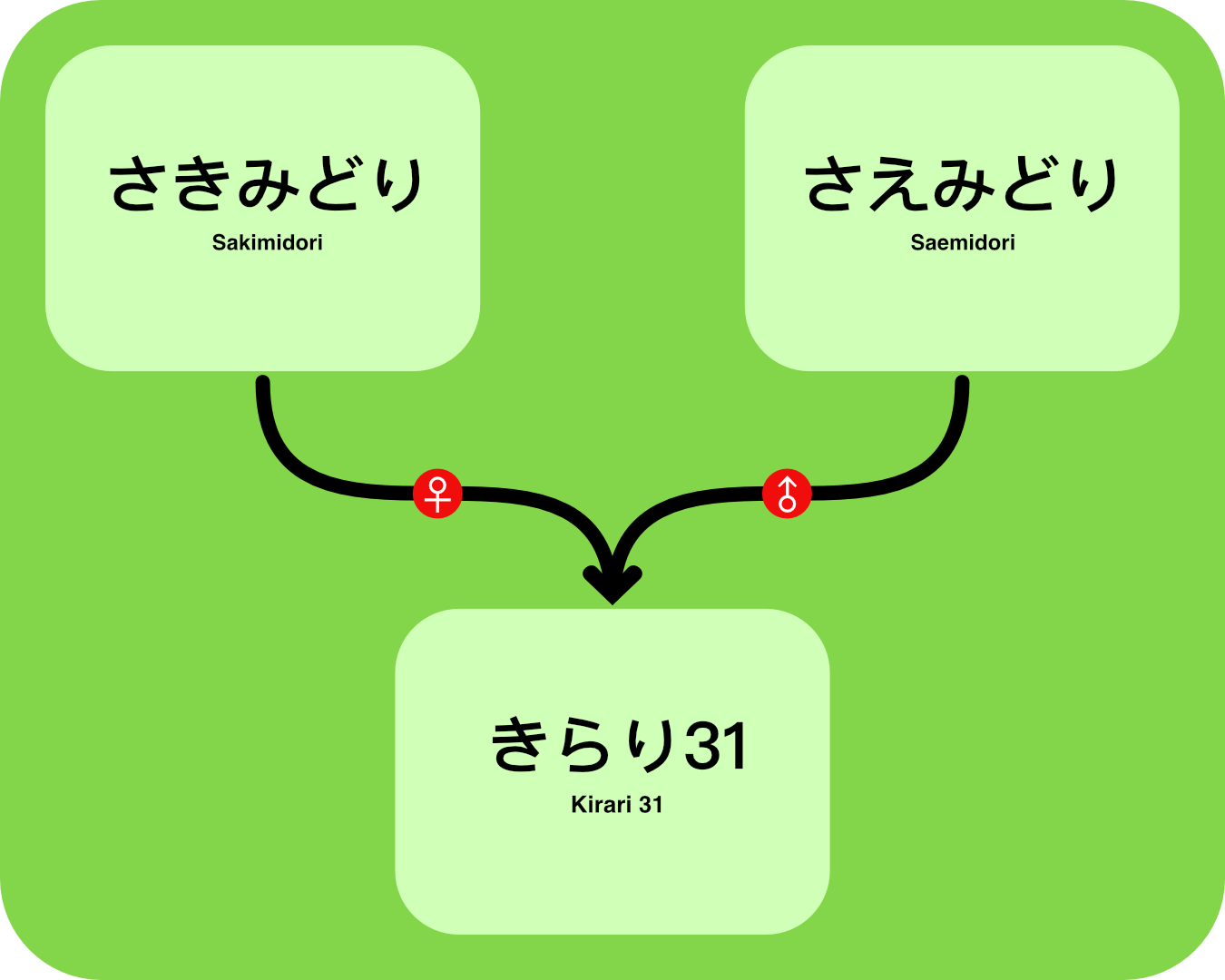
Crossed in 1994, using Sakimidori as the flower parent and Saemidori as the pollen parent. It was developed to counter the increase in frost damage events while ensuring high-quality tea with a value-added proposition. Sakimidori is an early-budding, cold-tolerant cultivar with excellent colour, while Saemidori is a rich, umami-forward cultivar with great processing quality.
Kirari 31 was selected from seeds resulting from that crossing and registered in December 2013, almost 20 years later. The crossing and development were carried out at the Miyazaki Prefectural Agricultural Experiment Station, Tea Research Branch, as part of a national effort for cultivar breeding. First, the national tea breeding designated trial programme (1958–2010) and later the AgriFood Science and Technology Research Promotion Programme (2011–2013).
After the crossing in 1994, seeds were collected on 19 October 1995. Of the 1,290 seeds sown in November 1995, 28 individual strains were selected by 1998 for excellent leaf colour and disease resistance. Those 28 lines were transplanted into field trials in May 1999, with the Kirari 31 named strain Mi99-23. Nutritional comparison trials from 1999 to 2003 investigated growth and quality. From 2004 to 2010, regional adaptation trials were conducted under the name Miyazaki No. 31, covering Mie, Kyoto, Kochi, Kumamoto, and six additional prefectures, for a total of 10. Shizuoka and Kagoshima joined the tests for Mochi disease and split-bark frost damage, respectively. From 2011 to 2013, additional trials investigated adaptability specifically for gyokuro and kabusecha production.
The combined data collected between 2010 and 2012 across 11 of the testing prefectures reported promising or somewhat promising results for Kirari 31. Mie, Kumamoto, Shiga, and Fukuoka showed the most promising results or interest. Its quality as sencha was reported excellent, and its processing as gyokuro and kabuse was reported superior to Saemidori.
Cultivar registration was filed in December 2013 under the Plant Variety Protection Act and published in May 2014 as Kirari 31. The development period spanned 19 years from crossing to registration and involved six different researchers.
The origin of the name, as explained in the release paper, is as follows. “Kirari” evokes a flash of light, while “31”, read in Japanese as san-ichi or sanjyuu-ichi, is a play of words (san = sun, ippai = full) symbolising something akin to basking in abundant sunshine. Noted from this is its bright colour, even when unshaded.
Characteristics
Key traits include early harvest, strong vigour, cold resistance, and higher yields than Yabukita. It’s also of similar or better quality in various teas, prized for high‑quality sencha, kabusecha, and gyokuro. Kirari 31 combines vigorous agronomic traits with great organoleptic ones.
Its budding period is about 4 days earlier than Yabukita, and it reaches harvest about 3 days earlier. Its yield is higher than both Yabukita and Saemidori, and the leaves retain their deep green colour for a longer period, between 21 and 27 days.
The tree has an intermediate form with a fan-shaped canopy and strong vigour. Its young leaves are long, elliptical, glossy green, with a similar thickness and size to Yabukita. The mature leaves are larger but still thin and lustrous. Yields from 5- to 8-year-old bushes averaged 511 and 520 kg per 10 a for spring and summer, respectively. Close to doubling the yields in spring and about 50% more in summer compared to Yabukita.
In terms of pest resistance, it shows strong resistance to frost-induced split bark injuries, with a lower incidence of winter bud damage. It is also robust against both red and blue blight. Ring spot resistance is medium and weak against anthracnose, mochi disease, shoot blight, and peach scale.
It has good adaptability and only requires minimal frost protection. Thus, it is a viable cultivar for most prefectures. This trait is especially interesting, as with global warming and a streak of years with frequent split-bark frost damage and bud damage, many younger fields, especially those with early-budding behaviours, generally suffer greatly from cold damage. These characteristics were particularly revealing in the trials from Saitama, which have particularly harsh cold conditions. Kirari 31 had a quite low incidence rate for both blue and red blight. With a higher resistance than the already cold-tolerant cultivars like Sayamakaori and Kanayamidori, this suggested no impediments to its growing in most Japanese tea production regions.
It is still fairly new and has been planted experimentally across Japan, but some commercial farms that planted plots with it have started to come online in recent years, making Kirari 31 more available in the market.
The reported survival rates for Kirari 31 seedlings average at 86%, somewhere between Yabukita (88%) and Saemidori (73%). After one year of age, that survival rate jumps to an average of 97% across the board. In the second year, Kirari 31's growth is higher in both canopy spread and height.
Its organoleptic properties showcase a fragrant cup, with some fruity or chestnut notes. A bright green liquor with excellent colour, aroma, and clarity. It was rated higher than both Yabukita and Saemidori in the sencha, kabuse, and gyokuro evaluations. This is in part due to its high free amino acid profile, which imparts the resulting tea with intense umami and contributes to its overall texture. Kirari 31 has a higher nitrogen absorption and utilisation rate than Yabukita, as measured at fertilisation time and in the fresh shoots. While this trial was short, the results reveal insights into other characteristics of the cultivar, such as its high free amino acid production, high yield, and wide window of colour deepening.
References
- 吉留克志 ほか, “耐寒性に優れ,煎茶,かぶせ茶及び玉露として高品質多収な早生品種‘きらり31’の育成,” 茶業研究報告 120 (2015). J-STAGEJ-STAGE
- “煎茶用品種候補 宮崎31号の系統特性評価,” 京都府農林水産技術センター研究報告, AgriKnowledge RN:2010902081 (2008). agriknowledge.affrc.go.jp
- “耐寒性に優れ…早生品種‘きらり31’の育成,” CiNii (Cir No. 1390001205338584960). CiNii Research